
Lab certificate · Harvest 25/26
ATTIMO Coratina, harvest 25/26
ATTIMO Coratina 25/26 was tested by HPLC at Chemiservice S.r.l., Monopoli, Italy on a sample received on 18 November 2025: 847 ±181 mg/kg total phenols, tyrosol equivalents, including 471 mg/kg oleocanthal and 336 mg/kg oleacein.
847 mg/kg
Total phenols · ±181
807 mg/kg
Oleocanthal + oleacein
HPLC
Method · COI/T.20/Doc. No 29/Rev. 2 2022
ISO/IEC 17025
Laboratory · Chemiservice
What's in it
Every compound the laboratory found, in mg/kg
Bars are drawn against the total. The report carries two assays, so oleocanthal and oleacein appear under both, at the level each one found.
| Compound | Result |
|---|---|
| Total phenols · as tyrosol Everything the method counts, expressed as the reference compound | 847 ±181 |
| Hydroxytyrosol · 3,4-DHPEA The free phenol most of the health evidence is built on | 5 |
| Tyrosol · p-HPEA Hydroxytyrosol's simpler sibling, and the compound the IOC total is expressed in | 5 |
| Decarboxymethyl oleuropein aglycone, open dialdehydic form · 3,4-DHPEA-EDA Oleacein under its chemical name, as the IOC method reports it | 151 |
| Decarboxymethyl ligstroside aglycone, open dialdehydic form · p-HPEA-EDA Oleocanthal under its chemical name, as the IOC method reports it | 190 |
| Lignans Pinoresinol and acetoxypinoresinol; mild, stable antioxidants | 78 |
| Oleuropein aglycone · 3,4-DHPEA-EA Oleuropein aglycone; bitter, and a carrier of hydroxytyrosol | 68 |
| Ligstroside aglycone · p-HPEA-EA Ligstroside aglycone; the tyrosol counterpart of oleuropein aglycone | 24 |
| Compound | Result |
|---|---|
| The peppery catch at the back of the throat; inhibits COX-1 and COX-2 | 471 |
| Oleocanthal's close relative, built on hydroxytyrosol; a strong antioxidant | 336 |
The IOC HPLC panel and the internal assay both report oleocanthal and oleacein, under different names and at different levels: p-HPEA-EDA 190 and 3,4-DHPEA-EDA 151 mg/kg by COI/T.20/Doc. No 29, against 471 and 336 mg/kg by internal method 13056-CH-1. Both are shown. Pages 2 to 16 carry a multi-residue pesticide screen (UNI EN 15662:2018) in which every listed residue is below its 0.010 mg/kg quantification limit.
How it was tested
HPLC at Chemiservice, Monopoli
Method
HPLC
COI/T.20/Doc. No 29/Rev. 2 2022
Separates the phenolic compounds and quantifies each one against tyrosol, then sums them.
Oleocanthal and oleacein come from a second assay on the same report, internal method 13056-ch-1.
How HPLC, NMR and Folin-Ciocalteu differ →Laboratory
Chemiservice S.r.l.
Monopoli, Italy
- ISO/IEC 17025
- Yes, as stated on the report
- Report
- 2533647 · Advance test report (Anticipo del rapporto di prova)
- Signed
- dr. Chim. Arianna Luisi (Ordine dei Chimici Bari A681)
- Operating according to UNI CEI EN ISO/IEC 17025
- Laboratory recognised by the International Olive Council for the physico-chemical analysis of olive oils and olive-pomace oils, Type A: advanced testing (01/12/2024 – 30/11/2025)
- Registered in the Regione Puglia list of self-control laboratories, registration no. 10P
- AOCS Approved Chemist 2025–2026
- FOSFA International analyst member
-
Received by the lab
18 November 2025
-
Tests began
20 November 2025
-
Tests completed
24 November 2025
-
Report issued
25 November 2025
Quality parameters
Inside the extra virgin limit on all 5 parameters
The same five figures every extra virgin oil in the EU has to meet, with the legal limit beside each one.
| Parameter | Result | Limit (EU and IOC) |
|---|---|---|
| Free acidity · % oleic acid | 0.19 ±0.03 | ≤ 0.80 |
| Peroxide value · meq O₂/kg | 7.2 ±1.2 | ≤ 20.0 |
| K232 | 1.62 ±0.14 | ≤ 2.50 |
| K268 (iso-octane) | 0.150 ±0.009 | ≤ 0.22 |
| ΔK | -0.003 ±0.001 | ≤ 0.01 |
Limits read from Reg. (EU) 2022/2104, Annex I and IOC COI/T.15/NC No. 3/Rev. 22, section 4, both checked on 21 September 2026; the two set identical values. ΔK is read as an absolute value, as the report notes. Uncertainties are the laboratory's expanded uncertainty (k = 2).
Reading this report
What this certificate tells you, and what it does not
One sample, one date
The laboratory measured the sample it received, on the day it ran the test. It did not measure every bottle.
Polyphenols fall after bottling
Heat, light, oxygen and time all lower them. Read the number against its date, and expect a lower one in the bottle you open later.
This one is HPLC
Totals from different methods count different things in different units. Compare this report only with another run on the same method, or compare named compounds.
How each method counts, and how to read any certificate: polyphenol analysis methods explained.
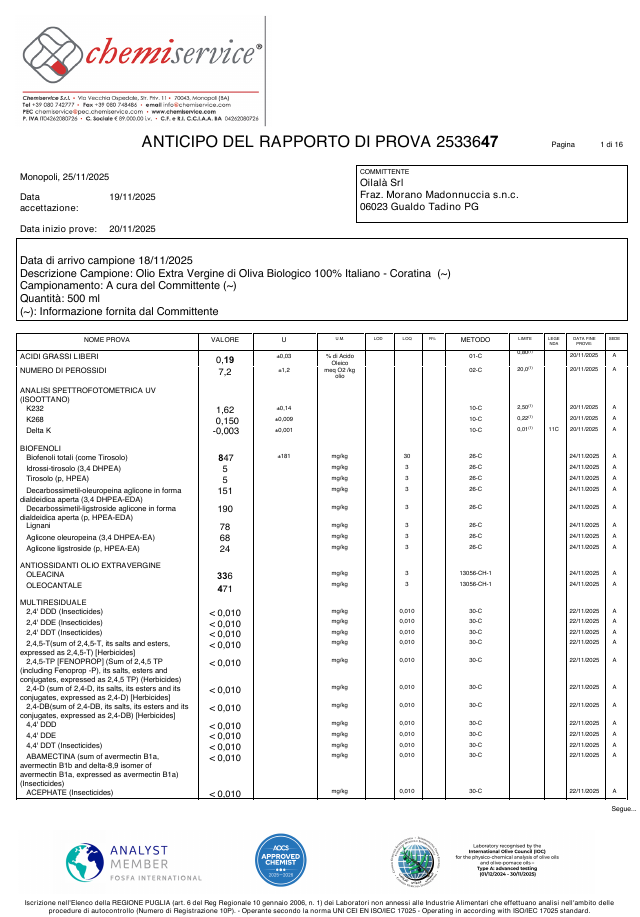
Original document
The report as the laboratory issued it
Every figure above was transcribed from this PDF. Open it, and check us.
Open the PDF
SHA-256 cfc16b11f1c681d205412d3c7ce3530922e28fef17164853ea4b417c2f1881f3
The document has not changed since publication if the file's hash matches this one.
Machine-readable record: coratina-2526-hplc-2025-11.json · all certificates