

Polyphenol analysis methods explained
The same olive oil can have 847 or 1,215 polyphenols, depending on how it's measured
Different methods result in different polyphenol totals for the exact same oil sample.
HPLC
The method we publish
847 mg/kg
Total polyphenols
NMR
The method most rivals publish
~1,215 mg/kg
Total polyphenols
Tested by
Chemiservice, Monopoli
Accreditation
ISO/IEC 17025
Method
IOC COI/T.20/Doc. No 29
How polyphenols are measured
HPLC vs NMR vs Folin-Ciocalteu
Olive oil carries dozens of different polyphenols. These three tests each count a different selection of them, in different units.
HPLC
Measures each bioactive polyphenol on its own
- How it works
- Pushes the oil through a tube packed so tightly that the polyphenols leave one at a time. Each is measured on the way out.
- What it reports
- Every compound separately, plus a total
- Blind spot
- Its total is stated in tyrosol equivalents, which the IOC says can read low
- Official status
- Official IOC method — Doc. No 29
NMR
Measures polyphenols in aggregate, as one total
- How it works
- Puts the sample in a strong magnet and reads the pattern that comes back, then works out which structures must be there to produce it.
- What it reports
- Selected compounds, plus a total built from a different set
- Blind spot
- Its totals are not built like HPLC totals, so they land higher on the same oil
- Official status
- Widely used, no IOC method
Folin-Ciocalteu
Estimates one total from a colour reaction
- How it works
- Adds a reagent the polyphenols turn blue. The darker the blue, the higher the number — so the oil is never separated into anything.
- What it reports
- One number, no compounds named
- Blind spot
- Anything in the oil that reduces the reagent is counted as polyphenols
- Official status
- Widely used, no IOC method
What is the IOC? The International Olive Council is the United Nations-backed body that writes the rules for olive oil — the grades, the tasting standards and the laboratory methods. It has published an official procedure for measuring polyphenols. Only HPLC follows it.
Case study: Coratina 25/26 harvest
Two Coratinas: phenolically weaker oil reads higher because of the NMR method
HPLC measures each bioactive polyphenol individually. NMR reads them in aggregate. That difference alone hands the weaker oil the higher headline number, while it carries less of the two phenols with the strongest evidence behind them: oleocanthal and oleacein.
ATTIMO Coratina 25/26
HPLCIOC Doc. No 29
Total polyphenols, as published
847 mg/kg
Not comparable across methods
Oleocanthal
471 mg/kg
Oleacein
336 mg/kg
The comparable figure
807 mg/kg
Chemiservice, report 2533647
Competitor Coratina
NMRNo IOC method
Total polyphenols, as published
1,295 mg/kg
Not comparable across methods
Oleocanthal
292 mg/kg
Oleacein
148 mg/kg
The comparable figure
439 mg/kg
World Olive Center, certificate C2526-00283
The number to compare
Oleocanthal & oleacein:
the main numbers to compare across tests
Polyphenols are a wide family and most types don't carry strong evidence behind them. Oleocanthal and oleacein do. Both are single molecules, so every laboratory reports them in the same milligrams and their sum survives a change of method.
Oleocanthal
The peppery catch at the back of your throat in a fresh oil. It blocks the COX-1 and COX-2 enzymes the same way ibuprofen does, at about a tenth of the strength by weight.
In ATTIMO Coratina 25/26
471 mg/kg
Oleacein
One of the most powerful antioxidants found in any food, with its own cardiovascular evidence behind it. Most oils carry very little, so it separates them sharply.
In ATTIMO Coratina 25/26
336 mg/kg
471 + 336 = 807 mg/kg
Oleocanthal + oleacein · ATTIMO Coratina 25/26
52 calories of ATTIMO Coratina 25/26 carry the same polyphenols as 245 calories of supermarket oil
A higher-quality oil gets you more polyphenols for fewer calories.
Olive oil calories needed for 5 mg of polyphenols
The oleocanthal mechanism was first reported in Nature in 2005. These are research findings on isolated compounds; olive oil is a food, and nothing here is a claim to treat or prevent disease.
Our choice
HPLC is the only test that shows what the total is made of
Only a few of the dozens of polyphenols in olive oil have a proven mechanism in the body. A total counts them all the same, so a big number can be padded with compounds that do nothing for you. HPLC lists them one by one.
It itemises the total
Doc. No 29 puts a figure against each compound it finds. You see what the number is made of instead of trusting that it is made of the right things.
Anyone can make us repeat it
It is the International Olive Council's published protocol. Send ATTIMO Coratina 25/26 to another accredited lab, ask for the same method, and the number should come back.
It prints its margin of error
Our certificate reads 847 ±181 mg/kg, and names the range the method is validated across. A number with no margin is a number nobody has checked.
Your checklist
How to assess olive oil polyphenol claims
Most bottles fail on the first one. A producer who can answer all six has given you something you can verify.
Which test?
HPLC, NMR or Folin. Without it the number has no units you can read.
Which lab?
A result with no laboratory behind it cannot be queried.
Accredited?
ISO/IEC 17025 covers testing competence. ISO 9001 does not.
Which harvest?
Polyphenols peak at early harvest and fall from there.
Sampled when?
The gap between pressing and testing is part of the number.
Compounds listed?
Oleocanthal and oleacein on their own lines, not folded into a total.
We bring the receipts
Every number we publish, with the report it came from
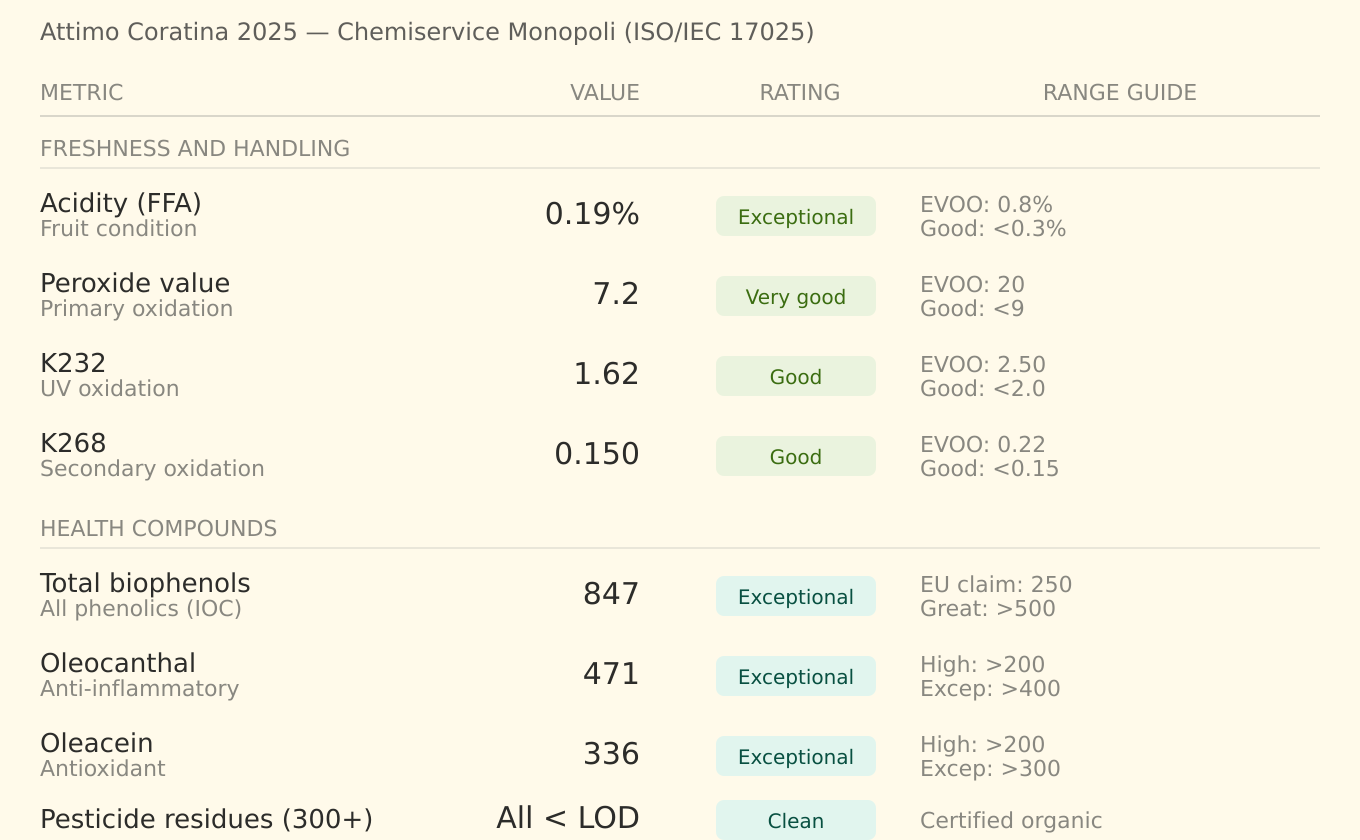
Both oils, analysed by Chemiservice in Monopoli — an ISO/IEC 17025 laboratory recognised by the International Olive Council for advanced testing. Each report opens in full.
| Oil | Total | Oleocanthal | Oleacein | Report |
|---|---|---|---|---|
| Coratina 25/26 | 847 ±181 | 471 | 336 | 2533647 |
| Nocellara 25/26 | 400 ±112 | 137 | 209 | 2533283 |
All values mg/kg, 2025/26 harvest, HPLC by IOC Doc. 29 with oleocanthal and oleacein from a dedicated assay. Coratina sampled 18 November 2025, Nocellara 17 November 2025. Doc. 29 states a measuring range of 30–800 mg/kg, so our 847 sits just above it and should be read as approximate at that boundary.
Questions about polyphenol testing
Full comparison of the three methods
| HPLC (IOC) | NMR | Folin | |
|---|---|---|---|
| What it does | Separates the phenolic fraction and quantifies compounds one at a time | Reads a magnetic resonance spectrum and assigns signals to structures | A colour-change reaction read on a spectrophotometer |
| What it reports | Compound-by-compound breakdown plus a total in tyrosol equivalents | A total plus selected named compounds, in absolute mass | One total, in gallic or caffeic acid equivalents |
| IOC status | Recognised — Doc. No 29 | Not recognised | Not recognised |
| Known limitation | Tyrosol-equivalent totals run low; the IOC states this itself | Counts a narrower compound set on a different mass basis | Responds to reducing capacity rather than to phenols specifically |
Sources and full references
- International Olive Council — COI/T.20/Doc. No 29/Rev.2 (2022)
- Regulation (EU) No 432/2012
- EFSA NDA Panel — EFSA Journal 2025;23(5):e9470
- Olmo-García et al. — J. Chromatogr. A 2019;1585:56–69
- Castillo-Luna & Priego-Capote — Antioxidants 2026;15(4):511
- Starec et al. — Molecules 2021;26(1):242
- Everette et al. — J. Agric. Food Chem. 2010;58(14):8139–8144
- Beauchamp et al. — Nature 2005;437:45–46
- Karkoula et al. — J. Agric. Food Chem. 2014;62:600–607
Buy an olive oil whose numbers you can check
Every ATTIMO bottle carries its harvest, its sample date and a certificate you can open before you order — oleocanthal and oleacein on their own lines.
See the oils and their certificates