Should You Cook With Olive Oil?
The question of whether to cook with olive oil spans a wider range than the framing usually suggests.
At one end: oil used raw, over salads, over warm pasta, as a finishing drizzle. At the other: high heat, searing meat, shallow frying. Between those two points sits a range of everyday cooking — softening vegetables slowly, roasting at moderate temperature, frying an egg, baking a focaccia — where the answer is less obvious. What an oil can handle, and what it loses, shifts considerably across that range.
Most people already treat finishing oil as a separate category and do not think of it as cooking. The harder question is what happens once heat is involved, and that question does not have a single answer because heat is not binary, but a scale.
TL;DR
- Olive oil is chemically stable under heat, more so than most seed oils.
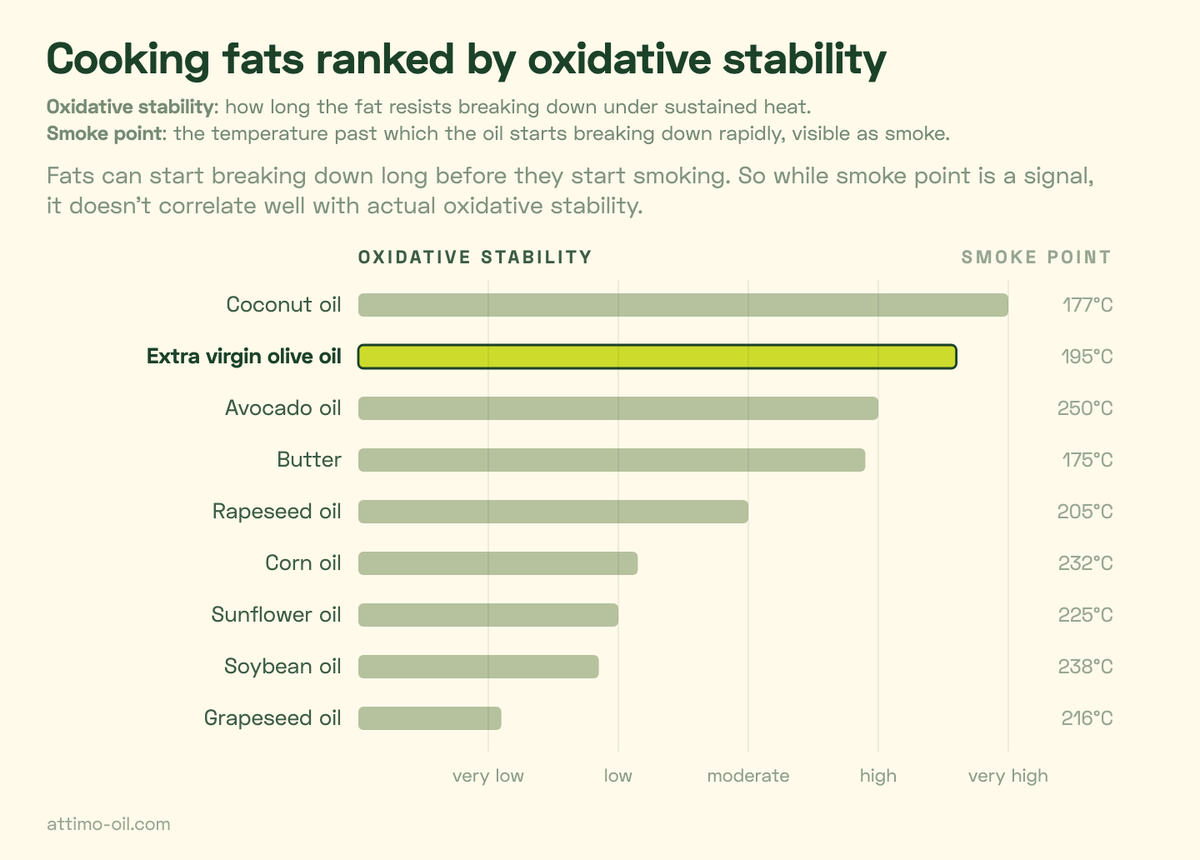
- Smoke point is not the primary indicator of cooking safety. Oxidative stability — how resistant a fat is to breaking down under sustained heat — matters more.
- Cooking is a spectrum. Dressing a salad and searing a steak are not the same question.
- Heat doesn't make olive oil harmful. It does degrade the polyphenols and aromatics that make a high-quality oil worth using.
- Early-harvest, high-polyphenol oils can be cooked with, but most of what distinguishes them will not survive prolonged heat.
- ATTIMO oils, all early-harvest, work well raw and at gentle heat — a soffritto, vegetables into the oven at 180°C. Not designed for high heat, where the polyphenols are gone before the food is cooked.
- The more useful question is not whether to cook with olive oil but which olive oil belongs in the pan.
What makes a cooking oil stable
Oils degrade as they are heated. The rate and nature of that degradation depends on two things: fatty acid composition and oxidative stability.
- Fatty acid composition determines baseline stability. Monounsaturated fats — with a single double bond in their molecular structure — are inherently more resistant to heat than polyunsaturated fats, which have multiple double bonds and more sites available for oxidation. Most seed oils are high in polyunsaturated fats. They degrade faster under sustained heat and generate more oxidation byproducts as they do.
- Oxidative stability describes how well an oil resists breaking down as temperature rises. Higher oxidative stability means fewer degradation compounds forming in the pan. Extra virgin olive oil is high in oleic acid — a monounsaturated fat that gives it strong inherent stability. Its polyphenols reinforce this further, chemically interrupting the oxidation chain and slowing degradation. Refined seed oils, stripped of antioxidants during processing, lack this protection.
How common cooking oils compare:
| Oil | Dominant fat type | Oxidative stability | For cooking |
|---|---|---|---|
| Extra virgin olive oil | ~75% MUFA (oleic acid) | High, reinforced by polyphenols | Excellent |
| Avocado oil | ~70% MUFA | High | Excellent |
| Butter / Ghee | ~65% saturated fat | High | Good |
| Coconut oil | ~90% saturated fat | Very high | Good, use in moderation |
| Rapeseed / Canola oil | ~60% MUFA | Moderate | Fair |
| Sunflower oil | ~65% PUFA | Low | Poor |
| Corn oil | ~55% PUFA | Low | Poor |
| Soybean oil | ~60% PUFA | Low | Poor |
| Grapeseed oil | ~70% PUFA | Very low | Poor |
Smoke point and what it doesn't tell you
Smoke point is the temperature at which an oil begins to visibly smoke.
At that moment, triglycerides are hydrolysing, splitting into free fatty acids and glycerol, with the glycerol breaking down into acrolein, the sharp volatile compound behind that blue-grey smoke. Repeatedly exceeding the smoke point does degrade an oil, and acrolein is something you want to minimise.
The problem is that oxidation, a more damaging form of degradation, begins well before visible smoke appears. When the double bonds in unsaturated fatty acids react with oxygen under heat, they generate aldehydes, peroxides, and other compounds that accumulate in the oil.
Polyunsaturated fats are far more vulnerable to oxidation than monounsaturated fats. Refining an oil removes free fatty acids, which raises its smoke point, but does nothing to protect its polyunsaturated fat from oxidising at 160°C. A high smoke point on a seed oil is not evidence of stability. It is a measurement of one specific threshold, not the overall behaviour of the fat under heat.
Extra virgin olive oil smokes at around 190–200°C, well within the range of most home cooking. Its high oleic acid content gives it good inherent resistance below that threshold, and its polyphenols slow oxidation further.
What heat does to olive oil
Olive oil contains fat, polyphenols, and aromatic compounds. Each responds to heat differently.
- The fat — oleic acid — is stable. It survives heat well across a wide temperature range and is not significantly altered by normal cooking.
- The polyphenols are more sensitive. These are the compounds responsible for the bitterness, the pepper at the back of the throat, the structural character of a high-quality early-harvest oil — and also the compounds most associated with olive oil's health properties. Heat degrades them. Some survive gentle cooking. Most do not survive prolonged high heat.
- The aromatic compounds — the grassy, green, freshly-cut complexity of an early-harvest oil — are the most volatile. They begin to dissipate at relatively low temperatures, well before the oil approaches its smoke point.
The consequence is that cooking with olive oil causes no harm. The fat remains intact. What changes is the sensory and nutritional profile built from polyphenols and aromatics, and whether that loss matters depends entirely on what you were trying to preserve.
Harvest timing and cooking
Olive oil is not a uniform product. Harvest timing changes the chemistry of an oil, and that chemistry determines how much it has to lose under heat.
Early-harvest oils, pressed from green olives in their defensive phase, are dense with polyphenols, the compounds that produce bitterness, pungency, and the structure you taste in a high-quality oil. They are also the compounds most degraded by heat.
Late-harvest oils come from fully ripe fruit with lower polyphenol content, higher fat concentration, and a milder, more neutral flavour profile. Under heat, they lose proportionally less, because there is less to lose.
An early-harvest oil used for high-heat cooking remains a healthy fat. The oleic acid survives. What does not survive are the polyphenols and aromatics that justify its price and distinguish it from a generic cooking fat. A late-harvest oil used the same way loses very little, because that is what it was built for.
Variety doesn’t really matter. Picual is often recommended for cooking because of its high oleic acid content and structural stability. But that recommendation applies to late-harvest Picual. Early-harvest Picual carries the same polyphenol load as any early oil. Same variety, same trees, different harvest timing, different oil, different purpose. Variety alone tells you very little about an oil's appropriate use. Harvest timing is what determines it.
Cooking is a range, not a binary
The practical question is not whether to cook with olive oil but at what heat and for how long, because those variables determine what survives and what does not.
| Heat range | Example uses | What happens | Optimal oil |
|---|---|---|---|
| No heat, below 40°C | Vinaigrette, marinades, finishing over warm food | Nothing degrades. Polyphenols intact. Full aromatic expression. | Early-harvest, high-polyphenol EVOO |
| Gentle heat, 40–120°C | Softening onions, poaching fish, confit | Some aromatics soften. Polyphenols begin to decline but remain present. Fat stays stable. | Early- to mid-harvest EVOO |
| Moderate heat, 120–180°C | Frying eggs, roasting vegetables, baking, pan-frying fish | Most aromatics lost. Polyphenols drop significantly. The oil's role becomes primarily functional. | Mid- to late-harvest EVOO |
| High heat, 180–220°C | Searing meat, shallow-frying | Polyphenols largely gone. The oil behaves as a fat. | Late-harvest olive oil, selected for high oleic acid and stability |
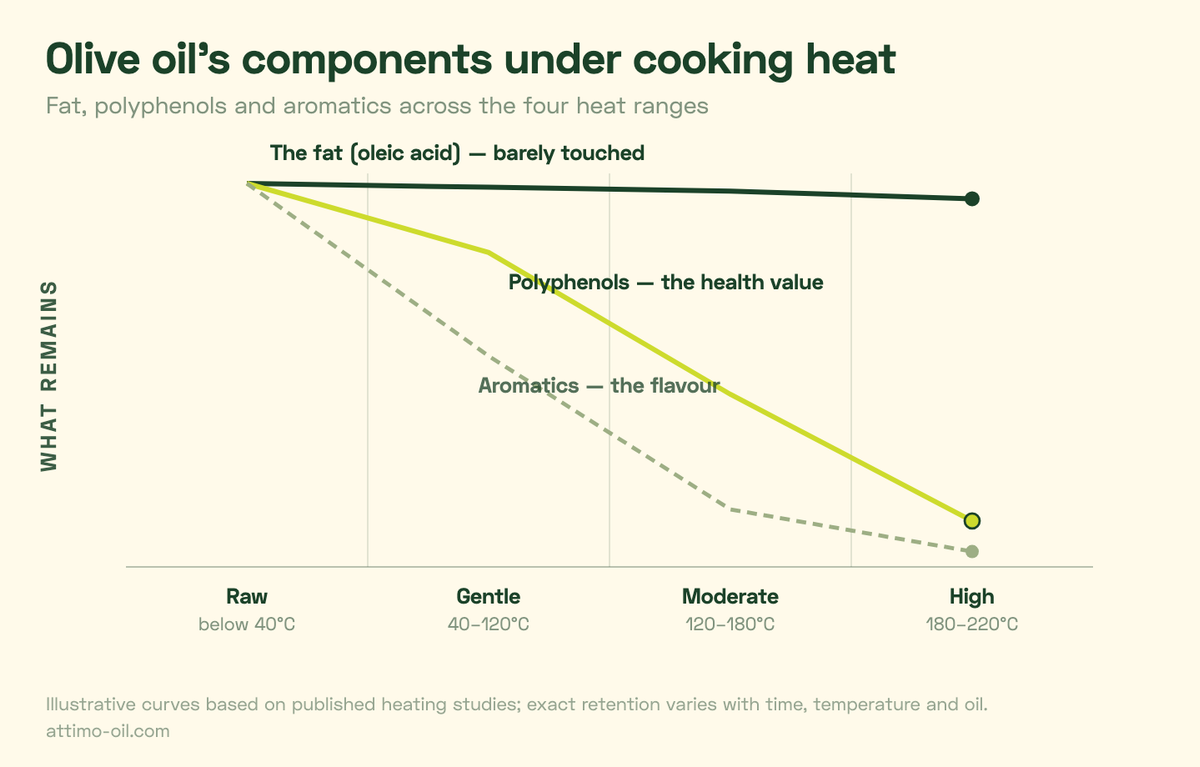
The earlier the harvest, the more an oil has to offer raw, and the more of that is lost to heat. For oils built around polyphenols and aromatic complexity, raw or low-heat use is where they perform as intended.
ATTIMO oils for cooking
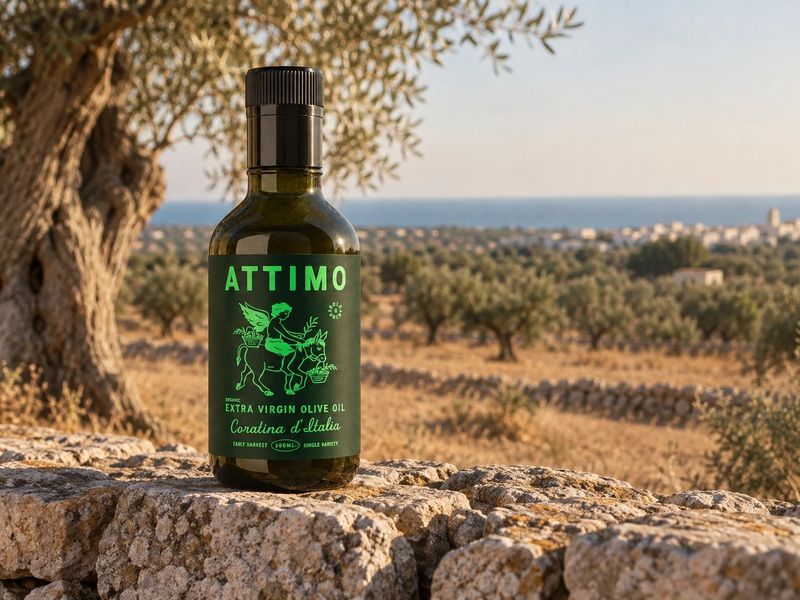
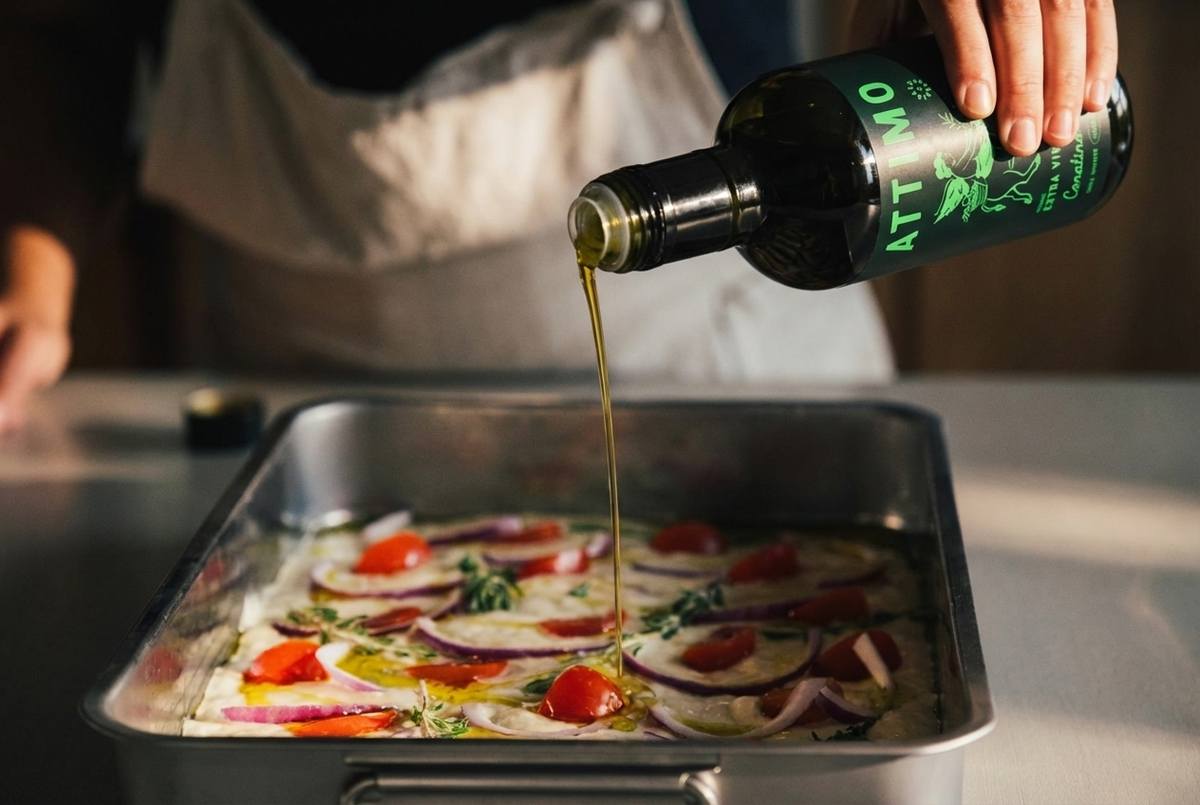
Our 2026 lineup (Nocellara, Coratina, and Picual) are all early-harvest oils, all high in polyphenols, all selected for character rather than yield. They were not designed for a hot pan, but that does not mean they have no place in cooking. At gentle and moderate heat they remain both useful and healthy — a Nocellara softening slowly with garlic and herbs at low heat, a Coratina carrying the base of a soffritto, a Picual used to coat vegetables before they go into the oven at 180°C. In those situations the fat does its job well, and something of the oil's character survives. What does not survive is sustained high heat — the oil you would use for searing meat or deep frying. At those temperatures the polyphenols are gone before the food is cooked.
A cooking oil built along our lines would look different: later harvest, high oleic acid, lower aromatic complexity, chosen for stability under heat rather than expression over food. That oil is not currently in our lineup, not by oversight, but because it is a different product with a different purpose. Our focus has been on oils that reward attention and raw use.
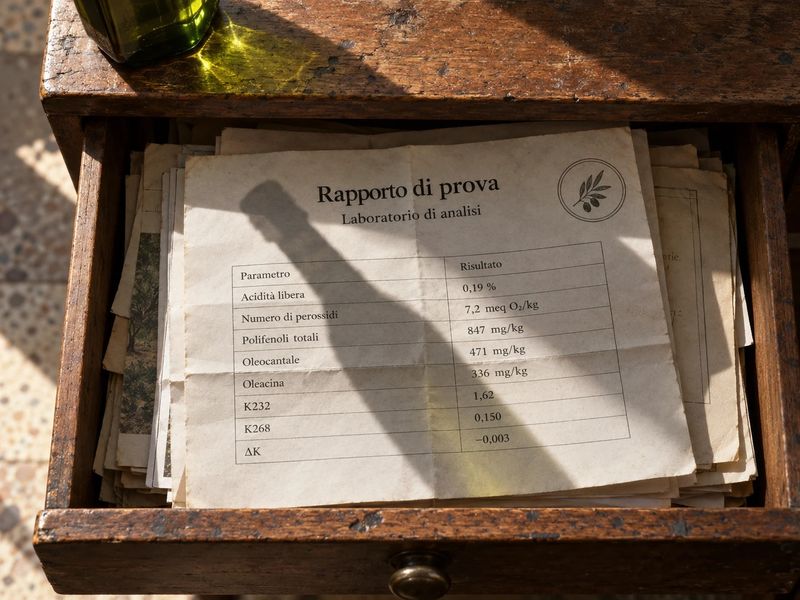
When we add a cooking oil, it will be specific: a variety and harvest stage chosen deliberately for heat, with the same lab-verified criteria we apply to everything else.
Until then, our oils belong over a salad, over warm food, or at low heat. That is where they perform best.
FAQ
Is olive oil safe to cook with?
Yes. Its high oleic acid content and natural antioxidants make it one of the more stable cooking fats available. The concern that it produces harmful compounds at normal cooking temperatures is not supported by the evidence.
What about smoke point?
Smoke point is one indicator but not the primary measure of cooking safety. Oxidative stability — how resistant the fat is to breaking down under sustained heat — is more meaningful, and olive oil performs well on this measure compared to most seed oils, including some with higher smoke points.
Can I use early-harvest olive oil for cooking?
You can. It remains a healthy fat under heat. But most of the polyphenols and aromatics that distinguish it from a standard cooking fat will be lost. For high-heat cooking, the additional cost of an early-harvest oil does not correspond to an additional benefit.
Why is Picual often recommended for cooking?
Because it is high in oleic acid and oxidatively stable. That recommendation applies to late-harvest Picual. Early-harvest Picual carries the same high polyphenol content as any early oil, and the variety does not change how heat affects those compounds.
What is the difference between a finishing oil and a cooking oil?
A finishing oil is used raw or at very low heat, where its polyphenols and aromatics remain intact and contribute to the flavour and nutritional profile of the dish. A cooking oil is selected for stability under heat. These are different briefs.
Can I reuse olive oil after frying?
Not recommended. Each heating cycle accelerates oxidation and degrades the fat structure further. Oil used for high-heat cooking has already undergone significant change and should not be reused.