Is Olive Oil A Natural Ozempic? What The GLP-1 Science Says
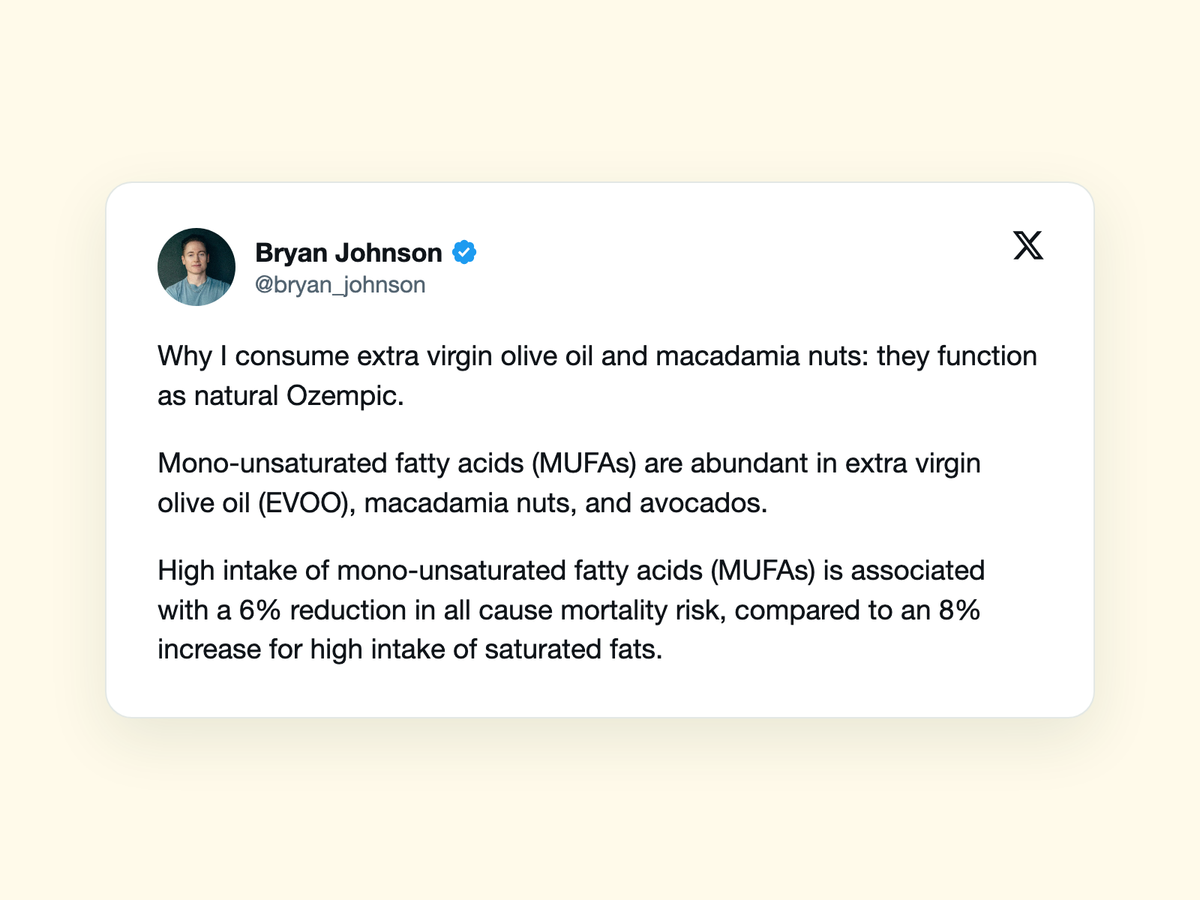
Bryan Johnson is the tech founder who spends two million dollars a year trying to not die. At the start of last year, he handed his followers a new reason to drink olive oil:
Ozempic is a medicine that helps people lose weight. Built for type 2 diabetes, it became famous when the weight loss turned out to be dramatic; by 2023 demand ran so high that pharmacies worldwide were short of it.
TL;DR
- Bryan Johnson calls olive oil a natural Ozempic. The comparison points at real biology: olive oil touches the same fullness hormone the drug is built on, called GLP-1.
- Ozempic holds a laboratory copy of GLP-1 in your blood at roughly a thousand times natural levels. In its landmark trial, people lost 14.9% of their body weight in 68 weeks.
- An olive-oil meal raises your own GLP-1 for a few hours. The best weight result ever measured for olive oil is about one kilogram, in women who were dieting anyway.
- Berberine and psyllium wore the "nature's Ozempic" name before olive oil; each marks a food with real metabolic effects, all of them modest next to the drug.
- Protein, fibre-rich food and exercise support your own GLP-1. No food comes near the injection.
- The case for olive oil lies elsewhere: polyphenols, protection of blood lipids, replacing worse fats.
How Ozempic works
After you eat, your gut releases a hormone that tells your brain the meal has arrived. Hunger fades, the stomach slows down, you push the plate away. Scientists call the hormone GLP-1; you can think of it as the body's fullness signal.
The signal fades fast. Within a minute or two your blood breaks the hormone down, so that hunger can return in time for the next meal.
Ozempic's active ingredient, semaglutide, is a laboratory copy of that hormone, rebuilt so the body cannot break it down. One weekly injection keeps the copy circulating for days, at levels roughly a thousand times higher than anything a meal produces. A fullness signal that never fades.
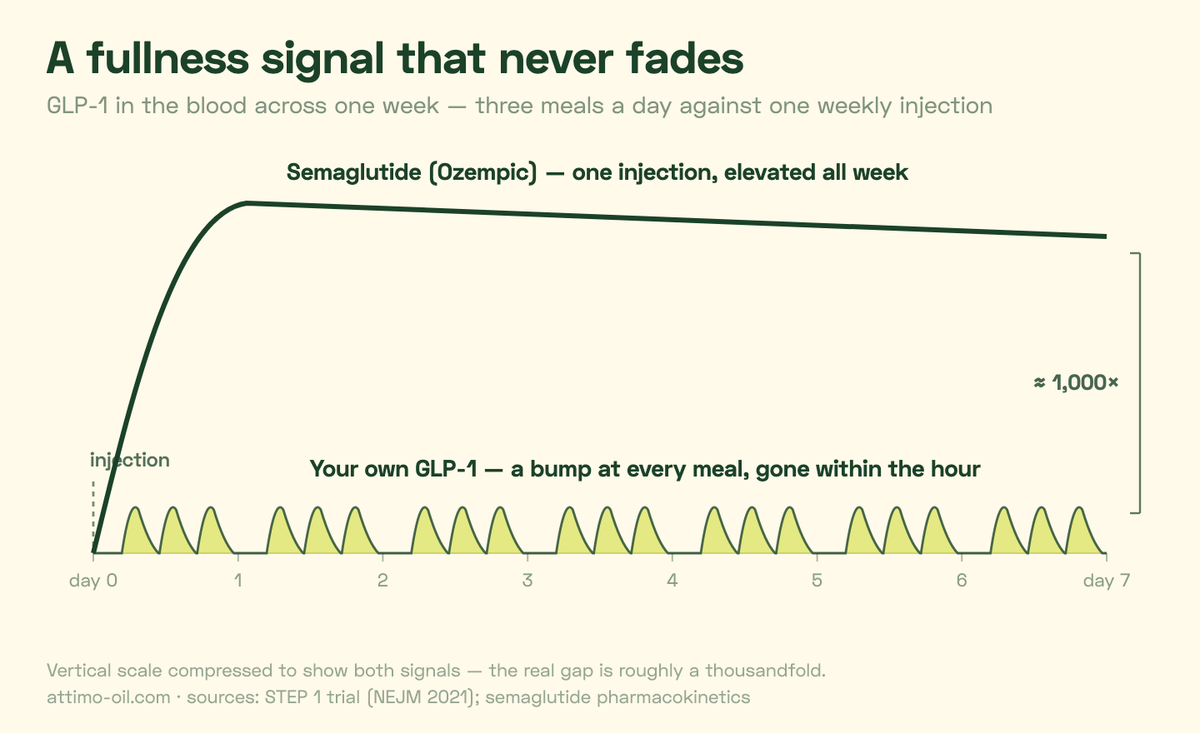
In the trial that made it famous, 1,961 adults received either the weekly injection or a placebo for 68 weeks. The placebo group lost 2.4% of their body weight; the semaglutide group lost 14.9%. Around fifteen kilograms for many participants, from appetite alone.
Zachary Knight, a professor at UCSF who studies how the brain controls appetite, on what that scale means for food:
Does olive oil increase GLP-1?
A little, briefly; and through more than one route.
The most direct evidence comes from Danish meal studies. Healthy volunteers ate test meals rich in olive oil on one day and rich in butter on another; after the olive-oil meals, their guts released more GLP-1 over the following hours. The same team later found the same pattern in people with type 2 diabetes. Real, measured in about a dozen people per study, and gone by evening.
A second route runs deeper. Your small intestine converts oleic acid, the main fat in olive oil, into a molecule called OEA that signals you have had enough. In rats and mice this pathway is beyond doubt; switch it off and fatty food stops being filling. In people, the evidence comes from capsules of purified OEA rather than from oil: researchers who pooled ten small trials found small reductions in weight and waist size, and a new Australian study measured raised GLP-1 after supplementation just this month. Nobody has yet shown that eating olive oil moves OEA enough to change how much a person eats.
The third route is the one Johnson pointed at first, in May 2024:
The words he quotes come from Christopher Damman, a gastroenterologist at the University of Washington. Damman's point: bacteria in your lower gut ferment the parts of food you cannot digest, mostly fibre along with polyphenols, into small molecules that prompt your gut to release more GLP-1. Feed those bacteria well and you support the hormone from the inside; it is one of the better arguments for eating beans and whole grains. In that recipe, fibre does the heavy lifting and polyphenols assist. Olive oil brings no fibre and a few milligrams of polyphenols per spoonful, so its part in this particular mechanism is small.
On the podcast Diary of a CEO, Johnson went further: "It is better than Ozempic. It is." The study behind that claim, usually summarised as 5.2 pounds in nine weeks, followed 41 women who were all eating fewer calories than they burned; the group taking olive oil lost about one kilogram more than the group taking soybean oil. The dieting did the losing, and the oil added a kilogram to it.
Side by side:
| Intervention | Duration | Measured weight effect |
|---|---|---|
| Semaglutide, weekly injection | 68 weeks | −14.9% of body weight |
| Olive oil vs soybean oil, both groups dieting | 9 weeks | ~1 kg extra loss |
| Purified OEA capsules, ten trials pooled | 3–12 weeks | Small but detectable |
| Mediterranean diet with ~50 g olive oil daily | 5 years | No significant change |
| An extra 7 g of olive oil a day, 121,119 people followed | 4-year windows | −0.09 kg |
The largest food effect is one kilogram, in women who were already dieting. The drug's is fifteen percent of a body.
The other "nature's Ozempics"
Olive oil is not the first food to wear the name.
In 2023 it was berberine, a plant compound that lowers blood sugar in trials. TikTok gave it 127 million views and supplement shops sold out. Psyllium husk followed as "the poor man's Ozempic"; its gel-forming fibre slows the stomach and fills you up, which is as close to the drug's territory as food gets.
Each name points at something true. A root, a husk, an oil; ordinary foods that turn out to move the same levers a blockbuster drug was built to pull. The comparison is a compliment to the food, and a measure of how large the drug looms: anything that touches appetite or blood sugar now gets held up against it.
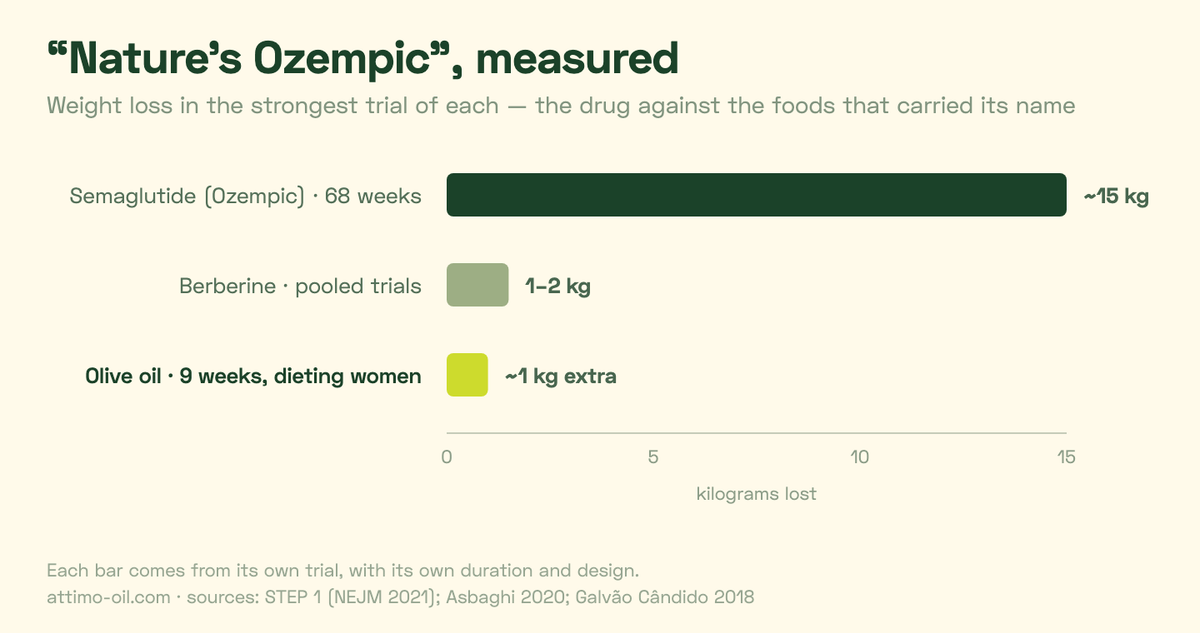
Berberine's pooled trials settled at one to two kilograms; olive oil's numbers are on the table above. Food moves these levers the way food does everything: gently, at meal scale, for a few hours at a time.
How to increase GLP-1 naturally
Some things do move the hormone, in food-sized amounts.
- Protein prompts more GLP-1 per calorie than any other nutrient; it is the most filling thing on a plate.
- The gel-forming fibre in oats, beans and psyllium slows the stomach and feeds the gut bacteria from Damman's mechanism. This is where his argument lives, in foods that contain fibre.
- Meals themselves. Every meal raises GLP-1 for a while; that is the hormone doing its job.
- Exercise and weight loss both make the body more responsive to its own signal.
None of it mimics the drug, and nothing edible does. A food nudges a signal that fades in minutes; the injection replaces it with one a thousand times stronger that never fades at all.
What olive oil is proven to do
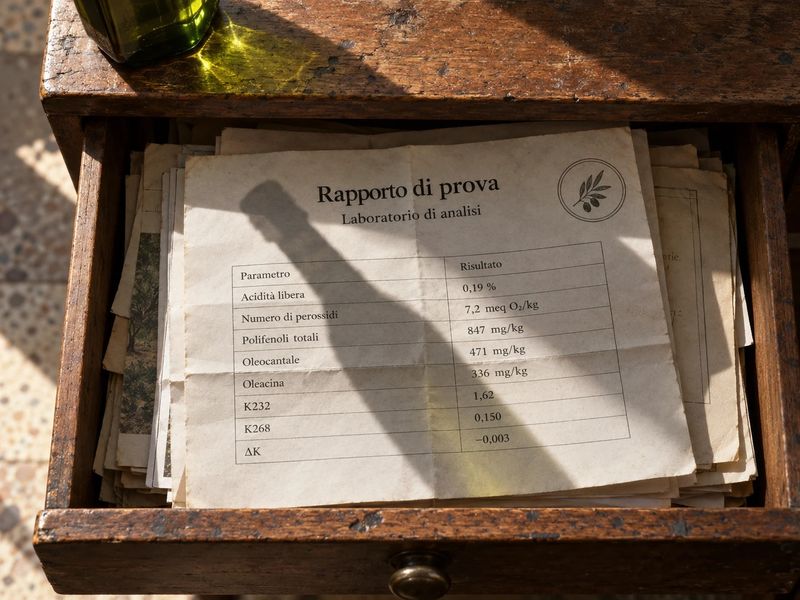
Olive oil's polyphenols carry Europe's authorised health claim: protection of blood lipids from oxidative stress, for oils delivering at least 5 mg of hydroxytyrosol and its relatives per 20 g. In the largest long-term studies ever run, people who replaced butter and margarine with olive oil lived longer. The amount those studies support is about one to one and a half tablespoons a day; the full dose breakdown is here, and a lab report tells you what any given batch contains.
The GLP-1 findings are younger evidence. Meals that raise a fullness hormone for a few hours; a pathway proven in rodents; one extra kilogram in a nine-week trial of 41 women.
Evidence like that comes in tiers:
- A scientific suggestion is the early tier: small groups, short windows, results that point somewhere and still need bigger trials.
- An authorised health claim is the far tier: findings repeated, reviewed by Europe's food-safety authority, and approved word for word.
The polyphenol evidence crossed into the second tier in 2012. The appetite evidence sits in the first, and may climb yet.
There will be a next nature's Ozempic. Some ordinary food is always turning out to hold more chemistry than it looked; that is what the nickname keeps finding, one food at a time. Olive oil took its turn because its compounds are real, and they stay real when the name moves on: the variety, the harvest, a polyphenol number a lab can confirm.
Bryan Johnson takes his olive oil every morning. So do we.
FAQ
Is olive oil a natural Ozempic?
No. An olive-oil meal raises your fullness hormone a little for a few hours; the drug holds a copy of that hormone in your blood at roughly a thousand times natural levels, permanently. Its landmark trial produced 14.9% body-weight loss. The best olive-oil study produced about one kilogram, in dieting women.
What is GLP-1?
A hormone your gut releases after eating that tells your brain you are full. It fades within minutes. Ozempic's active ingredient is a laboratory copy of it, rebuilt to last a week.
Did Bryan Johnson say olive oil is better than Ozempic?
Yes, on the podcast Diary of a CEO in 2024, citing a nine-week study of 41 dieting women in which the olive-oil group lost roughly one kilogram more. He has repeated the natural-Ozempic comparison since.
Does olive oil increase GLP-1?
For a few hours after a meal, yes; Danish studies found higher GLP-1 after olive-oil-rich meals than after butter-rich ones. No study connects this to eating less over weeks, or to losing weight.
What is OEA?
A molecule your small intestine makes from oleic acid, olive oil's main fat, that signals fullness. The pathway is well proven in rodents. Human trials use purified OEA capsules and find small effects; nobody has shown olive oil itself replicates them.
What foods mimic Ozempic?
None do. Protein, fibre-rich foods and regular meals stimulate your own GLP-1 briefly; exercise improves how the body responds to it. The drug works at a scale no food reaches, which is why it needs a prescription.
How can I increase GLP-1 naturally?
Eat enough protein, eat fibre that forms a gel (oats, beans, psyllium), exercise, and keep a healthy weight. Expect the effect of food on a hormone; no more.
Doesn't the calorie load cancel any appetite benefit?
Three tablespoons of olive oil is roughly 360 calories, which is why the dose question matters more than the appetite question. The evidence supports olive oil replacing other fats rather than being added on top of them.
What happened to berberine, the previous "nature's Ozempic"?
Its pooled trials settled at one to two kilograms of weight loss and the trend faded within a year. The compound still does what it did before the name arrived: lowering blood sugar modestly in trials.
Is any of this a reason to avoid olive oil?
No. It is a reason to choose it for what the evidence carries: the authorised blood-lipid claim, the substitution benefit, and polyphenol content you can verify on a lab report.
Sources
- Wilding JPH, et al. Once-Weekly Semaglutide in Adults with Overweight or Obesity (STEP 1). N Engl J Med. 2021;384:989–1002. https://doi.org/10.1056/NEJMoa2032183
- Thomsen C, et al. Differential effects of saturated and monounsaturated fatty acids on postprandial lipemia and incretin responses in healthy subjects. Am J Clin Nutr. 1999;69(6):1135–1143. https://doi.org/10.1093/ajcn/69.6.1135
- Thomsen C, et al. Differential effects of saturated and monounsaturated fats on postprandial lipemia and glucagon-like peptide 1 responses in patients with type 2 diabetes. Am J Clin Nutr. 2003;77(3):605–611. https://doi.org/10.1093/ajcn/77.3.605
- Schwartz GJ, et al. The lipid messenger OEA links dietary fat intake to satiety. Cell Metab. 2008;8(4):281–288. https://doi.org/10.1016/j.cmet.2008.08.005
- Effects of oleoylethanolamide supplementation on anthropometric indices: a systematic review and meta-analysis. Front Nutr. 2025;12:1553288. https://doi.org/10.3389/fnut.2025.1553288
- Galvão Cândido F, et al. Consumption of extra virgin olive oil improves body composition and blood pressure in women with excess body fat. Eur J Nutr. 2018;57:2445–2455. https://doi.org/10.1007/s00394-017-1517-9
- Estruch R, et al. Effect of a high-fat Mediterranean diet on bodyweight and waist circumference. Lancet Diabetes Endocrinol. 2019;7(5):e6–e17. https://doi.org/10.1016/S2213-8587(19)30074-9
- Guasch-Ferré M, et al. Changes in olive oil consumption and long-term body weight changes in 3 United States prospective cohort studies. Am J Clin Nutr. 2025;121(5):1149–1156. https://doi.org/10.1016/j.ajcnut.2025.02.012
- Damman C. Your body already has a built-in weight loss system that works like Wegovy. The Conversation. January 2024. https://theconversation.com/220272
- Knight Z. Reply, 29 May 2024. https://x.com/zaknight/status/1795950298965434754
- Asbaghi O, et al. The effects of berberine supplementation on obesity indices: a systematic review and meta-analysis. Clin Nutr ESPEN. 2020;38:43–49. https://doi.org/10.1016/j.clnesp.2020.04.010
- Commission Regulation (EU) No 432/2012, authorised health claims. https://eur-lex.europa.eu/legal-content/EN/TXT/?uri=CELEX:32012R0432