How Much Olive Oil Per Day? Bryan Johnson Takes 15% Of His Calories
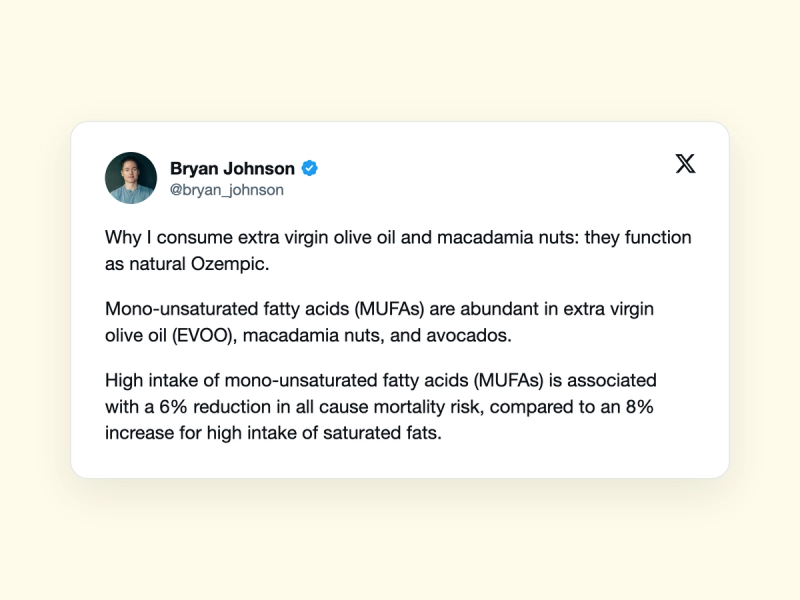
Bryan Johnson drinks 45 millilitres of extra virgin olive oil every morning and calls it 15% of his calorie intake.
The number travels because he is the most measured man alive. If anyone has done the arithmetic on what to put in a body, it should be him.
So we read the study he cites for it.
The highest olive oil intake in that study was more than 7 grams a day. Half a tablespoon. Bryan drinks about 41 grams — six times the amount that produced the 19% he quotes.
That gap is the whole question.
TL;DR
- Bryan Johnson drinks 3 tablespoons (45 mL, ~41 g) a day, roughly 360 calories, which he calls 15% of his intake.
- The study behind that claim defined its highest consumption category as more than 7 g a day. Half a tablespoon.
- Pooled across 13 cohorts and almost a million people, the benefit flattens around 20 g a day. Above that the data goes quiet.
- The 15% is an output of his 2,250-calorie budget. On 3,000 calories the same three tablespoons is 12%.
- Nearly every solid effect estimate comes from replacing another fat rather than adding oil on top.
- Millilitres are the wrong unit. You are dosing polyphenols, and concentration decides how much oil you swallow to get them.
- At 847 mg/kg, one spoon of our Coratina carries what a supermarket oil needs four to five spoons to match — at a quarter of the calories.
How much olive oil does Bryan Johnson drink?
Three tablespoons of high-polyphenol extra virgin olive oil, taken with food across his eating window.
In November 2023 he described it as one tablespoon with each meal. By October 2024 the same total had become a headline: 15% of calorie intake.
The arithmetic holds. 45 mL of olive oil weighs about 41 g, and at roughly 8.8 calories per gram that is 363 calories. Against his published 2,250-calorie budget, 16%. He rounded down.
There is a second number he does not publish, and it says more than the first.
| Blueprint protocol | Amount |
|---|---|
| Daily calories | 2,250 |
| Total fat | 101 g |
| Olive oil | ~41 g |
| Olive oil share of total fat | ~40% |
Two fifths of the fat Bryan Johnson eats is olive oil. He made it his primary fat and built the rest of the diet around it.
Which changes what you are being asked to copy. Adding three tablespoons to what you already eat is a different intervention from rebuilding which fats you eat.
For what he looks for in the oil itself, and how his thresholds hold up against a lab report, we went through that in our breakdown of Bryan Johnson's olive oil criteria.
The study he cites
Guasch-Ferré and colleagues, Journal of the American College of Cardiology, 2022. It followed 60,582 women and 31,801 men for 28 years, recorded 36,856 deaths, and reassessed diet every four years. Serious work.
Highest olive oil consumption against never or rarely:
| Outcome | Risk reduction | Hazard ratio (95% CI) |
|---|---|---|
| All-cause mortality | 19% | 0.81 (0.78–0.84) |
| Cardiovascular mortality | 19% | 0.81 (0.75–0.87) |
| Cancer mortality | 17% | 0.83 (0.78–0.89) |
| Neurodegenerative mortality | 29% | 0.71 (0.64–0.78) |
| Respiratory mortality | 18% | 0.82 (0.72–0.93) |
Now the detail that changes how the table reads.
That highest category was more than 7 grams a day — more than half a tablespoon, in the paper's own words. Mean intake inside it was around 9 g at baseline, rising to roughly 14 g when updated over time. It held about 5% of participants. More than half the cohort ate olive oil never or almost never.
So the 19% measures the distance between half a tablespoon and none.
It says nothing about the distance between one tablespoon and three. Nobody in that cohort was drinking 41 grams a day, which means the study cannot carry the dose it is being used to justify.
Two more findings from the same paper rarely survive the trip into wellness content.
Olive oil showed no significant advantage over other vegetable oils. Set against corn, safflower, soybean and canola combined, the association disappeared.
The authors' own conclusion is a substitution claim. In their words, the findings confirm dietary recommendations to replace animal fats with plant oils.
And the people eating the most olive oil were also more active, less likely to smoke, and eating more fruit and vegetables. The authors adjust for that and state plainly that residual confounding cannot be ruled out.
A percentage is a fraction
And fractions have denominators.
Bryan eats 2,250 calories a day, a deliberate 10% restriction. Three tablespoons against that budget is 16%.
Put the identical three tablespoons against 3,000 calories and it becomes 12%. Against 2,000, 18%. The oil never moved — the denominator did.
Which means 15% describes his calorie ceiling more than it describes olive oil. Copy the percentage on a bigger diet and you drink considerably more than he does, chasing a number that was never the point.
The transferable figure is the amount.
What the evidence supports
Three reference points, in ascending order.
7 g a day is where benefit shows up. Half a tablespoon, the level at which the Harvard cohorts found 19% lower all-cause mortality. A far smaller ask than protocol content implies.
20 g a day is where it stops climbing. A 2022 meta-analysis in Frontiers in Nutrition pooled 13 prospective cohorts covering roughly 974,000 people. It found curvilinear associations for cardiovascular disease and all-cause mortality both, with little additional or no risk reduction beyond approximately 20 g a day.
Twenty grams is a tablespoon and a half. It is the most useful number in the field and the least quoted, and what it buys still depends on what is dissolved in the oil — which we cover in our complete guide to high-polyphenol olive oil.
50 g a day is what the big trial used, and it proves less than people assume. PREDIMED randomised 7,447 high-risk Spanish adults to a Mediterranean diet with extra virgin olive oil, the same diet with nuts, or a control arm told to cut fat. The olive oil group reached about 50 g a day and returned a hazard ratio of 0.69 for major cardiovascular events.
The caveats are heavy enough that we would rather state them than leave them to someone else. PREDIMED tested a whole dietary pattern with regular dietitian support against a control group that got less contact time, so it isolates nothing. It ran no dose comparison — there was no 20 g arm to test 50 g against. That 50 g is an artefact of how much oil the trial handed out. It stopped early, and it was retracted and republished in 2018 after randomisation irregularities surfaced at several sites.
| Daily amount | Where it comes from | What it shows |
|---|---|---|
| ~7 g (½ tbsp) | Top category, Harvard cohorts | 19% lower all-cause mortality vs none |
| ~20 g (1½ tbsp) | EU health claim condition; meta-analysis plateau | Benefit flattens around here |
| ~41 g (3 tbsp) | Bryan Johnson's intake | Beyond the range any cohort measured |
| ~50 g (3½ tbsp) | PREDIMED olive oil arm | Works inside a whole diet; dose never tested |
The evidence runs strong from zero to about 20 g a day, then goes silent. Silence is not a warning: no study has found harm at high intake. But an absence of studies at 41 g gets presented as support for 41 g, and it is not that.
Can you drink too much olive oil?
No toxic dose has been established, and no trial has found harm at high intake. PREDIMED ran participants at around 50 g a day for close to five years and reported no relevant diet-related adverse effects.
The ceiling is practical rather than toxicological.
Calories come first. At roughly 120 per tablespoon, olive oil is among the most energy-dense things in a kitchen. Four tablespoons is close to 480 calories, which is a quarter of many people's daily intake and displaces a lot of food that carries fibre and protein.
Then digestion. Large single doses of any fat can loosen stools and bring on nausea, because fat slows gastric emptying and draws water into the gut. Splitting the amount across meals avoids most of it. Anyone without a gallbladder, or managing reflux, tends to find large single doses harder to handle.
Then diminishing returns. Past roughly 20 g a day the measured benefit stops climbing, so additional spoons buy calories rather than protection.
If you are on blood thinners, managing a chronic condition, or making a large change to your diet, that is a conversation for your doctor rather than a blog.
The unit problem
Here is where the conversation goes wrong.
Every article on this subject answers in tablespoons. Olive oil is a delivery vehicle, and what it delivers varies tenfold in concentration from one bottle to the next.
Two tablespoons of supermarket oil and two tablespoons of early-harvest single-variety oil are the same volume, the same calories, and different doses entirely.
European regulation says so outright. The authorised claim — that olive oil polyphenols contribute to the protection of blood lipids from oxidative stress — applies only to oils carrying at least 5 mg of hydroxytyrosol and its derivatives per 20 g. The threshold is written in milligrams of compound. Volume sits downstream of concentration.
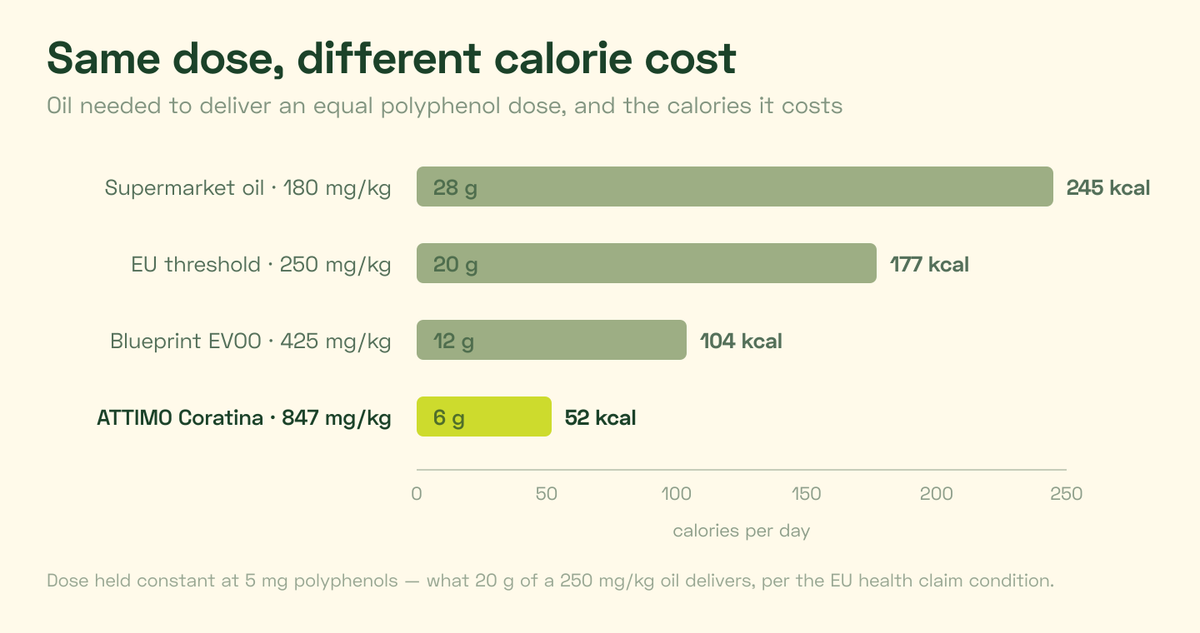
Run that through real oils, holding the polyphenol dose constant:
| Oil, by polyphenol content | Amount for the same polyphenol dose | Calories it costs |
|---|---|---|
| Typical supermarket oil, ~180 mg/kg | ~28 g (2 tbsp) | ~245 kcal |
| Entry threshold, 250 mg/kg | 20 g (1½ tbsp) | ~177 kcal |
| Blueprint EVOO, 425 mg/kg | ~12 g (just under 1 tbsp) | ~104 kcal |
| ATTIMO Coratina, 847 mg/kg | ~6 g (½ tbsp) | ~52 kcal |
Same polyphenol dose in every row. Roughly 190 calories a day between top and bottom — about 70,000 calories a year, spent to arrive at the same place.
One caveat the number deserves. Comparing polyphenol figures across brands only works when the same method sits behind them. Folin-Ciocalteu, HPLC and NMR return different results from the same oil, and NMR runs materially higher. A bottle claiming 1,200 mg/kg by NMR may be the same oil as one claiming 480 by HPLC. We publish the COI standard biophenol method from an accredited laboratory, and we walk through reading those numbers in our guide to olive oil lab reports.
Which gives the real answer to how much olive oil you should take: it depends on what is in the bottle. A producer who cannot tell you cannot answer the question.
How much high-polyphenol olive oil per day?
Less, which is the point of buying it.
The European condition is built on 20 g of an oil at the 250 mg/kg entry threshold. Concentration scales that down: an oil at 850 mg/kg reaches the same polyphenol dose in roughly a quarter of the volume.
In practice, for an oil in the 400–850 mg/kg range, a tablespoon to a tablespoon and a half a day covers it. Around 120 to 175 calories.
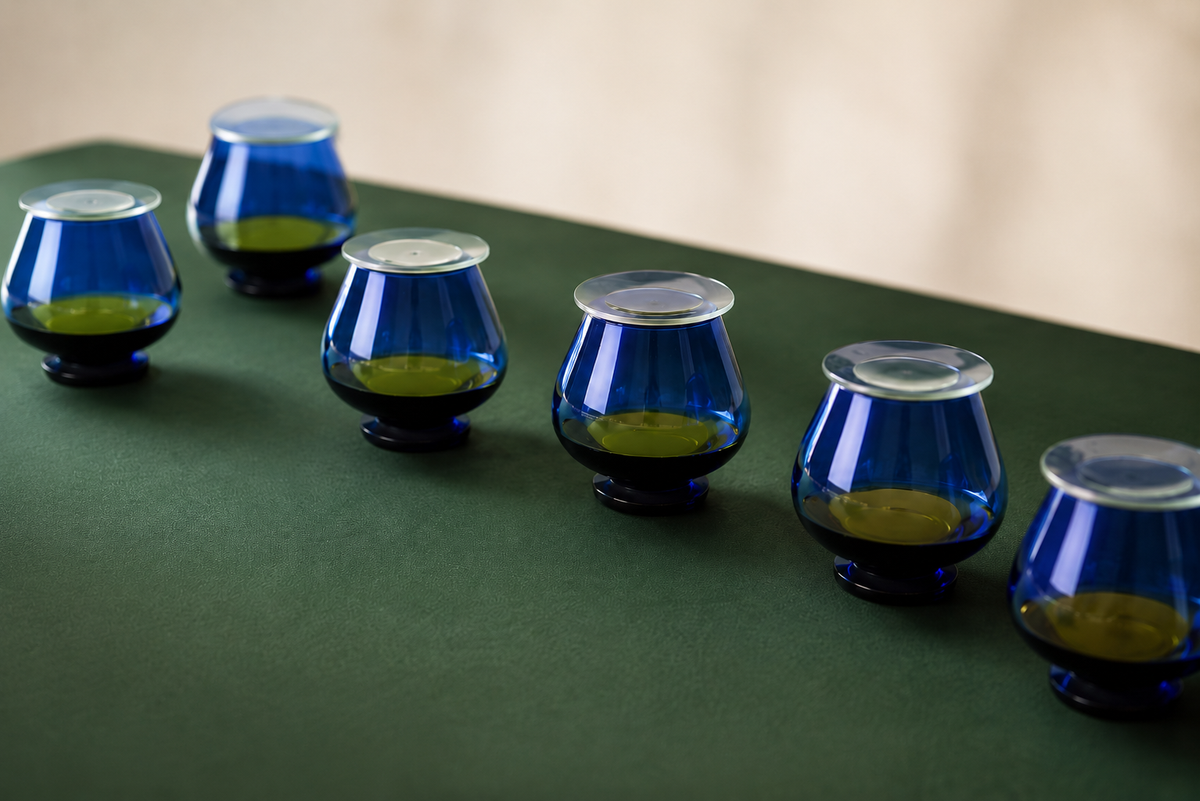
The trap is treating a high number as licence to take more. The number means you can take less and arrive at the same place, with room left in the day for food.
Swap, don't add
Three tablespoons is about 360 calories. That is nobody's rounding error.
The sharpest criticism of high olive oil intake is that it delivers a lot of energy without much fullness. Bryan's counter is that monounsaturated fat does its own work on appetite.
The satiety literature on monounsaturated fat is thinner than that framing suggests, and calling any food natural Ozempic is doing heavy lifting. But the underlying point survives, because of how the evidence was generated in the first place.
Look again at what the Harvard analysis measured. Replacing 10 g a day of another fat with olive oil tracked lower mortality: margarine 13% lower, butter 14%, mayonnaise 19%, dairy fat 13%. Against other vegetable oils, no significant difference.
The effect lives in the exchange.
A 2025 analysis of 121,119 people across three cohorts found the same shape for body weight. Each extra half tablespoon a day tracked slightly less weight gain over four years, while equivalent increases in other added fats went the other way. In PREDIMED, adding around 50 g of olive oil daily for five years with no calorie restriction produced no significant weight gain.
So the rule has to be specific to be worth anything:
- The butter on your bread, the margarine in the pan, the mayonnaise in the sandwich, the seed oil in your dressing. Those are the calories olive oil should be replacing.
- Three tablespoons on top of an unchanged diet is roughly 360 extra calories a day. If nothing else moves, that is well over a kilogram of body weight a month.
- Concentration buys you room here too. At 847 mg/kg you reach the same polyphenol dose in a third of the volume, so there is a third as much to make space for.
Bryan's protocol is the clean illustration. He built a 2,250-calorie budget in which olive oil is 40% of total fat. Something was displaced to make that fit.
Do you have to drink it?
No. And the clearest statement on that comes from his own company.
Blueprint's guidance on olive oil shots says some people claim a morning shot on an empty stomach increases the benefits, that no research backs it up, and that as far as anyone currently knows, timing and food pairing do not matter. Their recommendation is one to three tablespoons a day, taken as a shot or poured over salads and vegetables, or stirred into a shake.
Bryan does not take it as a shot either.
One tablespoon with each of three meals. Which matters, because the most common objection to this entire practice — just put it on your salad — is correct.
There is no established absorption advantage to drinking olive oil straight. Anyone claiming otherwise should be asked for the study.
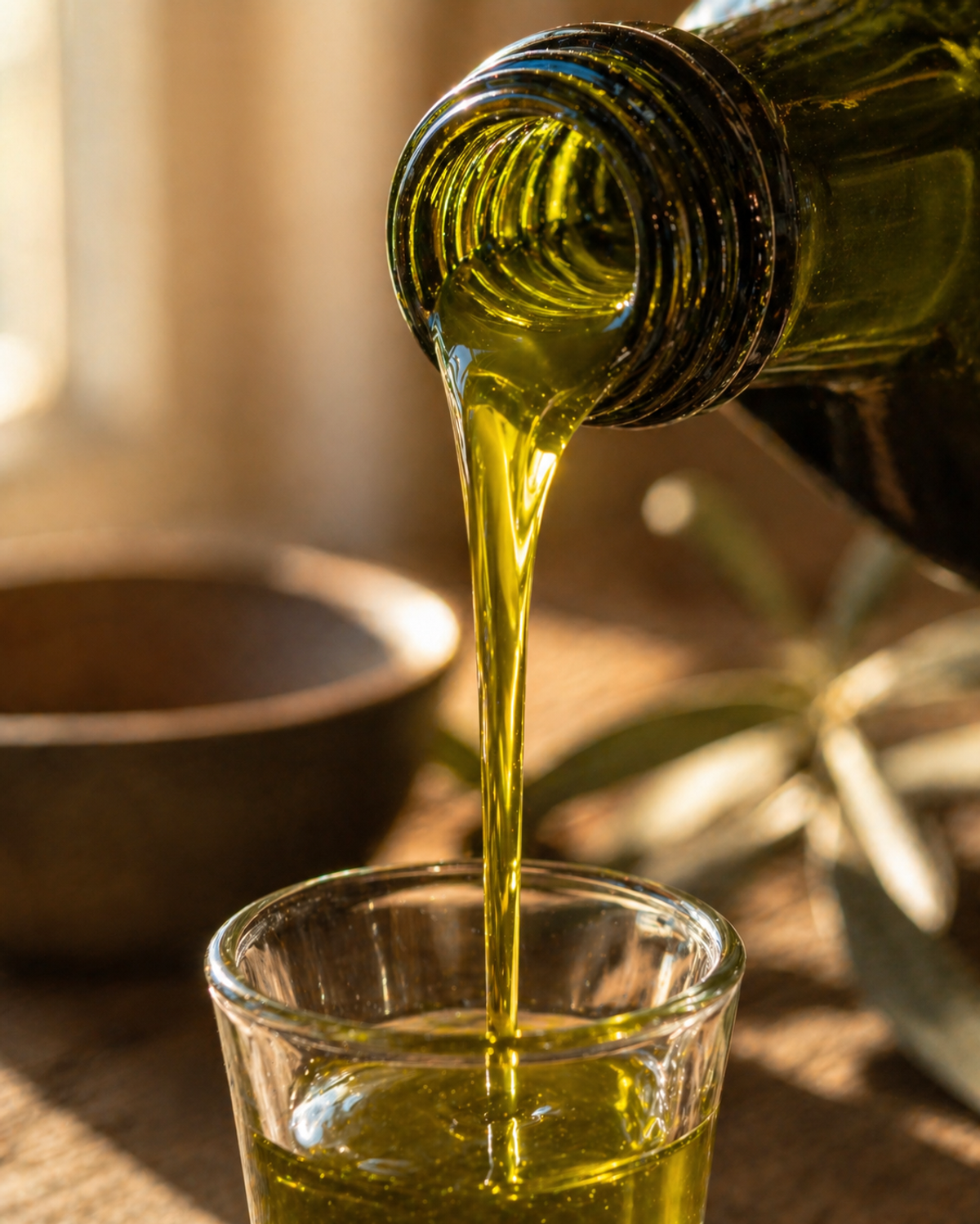
What a measured spoon gives you is dose reliability. A drizzle is an estimate. If you are treating olive oil as a daily intervention, knowing you took 15 mL has some value, and if you would rather eat it on food you lose nothing.
We wrote about where the format came from in why people are now drinking olive oil shots.
Take it raw
One qualifier sits on all of the above.
Polyphenols degrade with heat. Oleic acid survives cooking comfortably, so olive oil stays a good cooking fat — but the compounds you are counting in milligrams are the ones that break down in the pan.
If you are spending 360 calories a day on olive oil for its polyphenol content, that oil belongs on the spoon, over food, in dressings. Keep a straightforward everyday oil for heat. The full picture is in should you cook with olive oil.
Milling-day numbers
The last problem with dosing by concentration is that concentration moves.
Polyphenols degrade in the bottle. Light, oxygen, heat and time all take their cut. An oil that measured 800 mg/kg at pressing may deliver considerably less eighteen months on, and nothing on the label will tell you.
So your real dose rests on two things labels tend to hide: the analysis, and the harvest date. A polyphenol number without a harvest date describes an oil that existed at some point. A best-before date tells you when the producer stopped guaranteeing it, never when the olives were picked.
Which is why we only sell the current harvest, publish the analysis for every release, and print the harvest date on the bottle. It is also why harvest timing does most of the work in this category before a bottle is ever filled.
Where ATTIMO fits
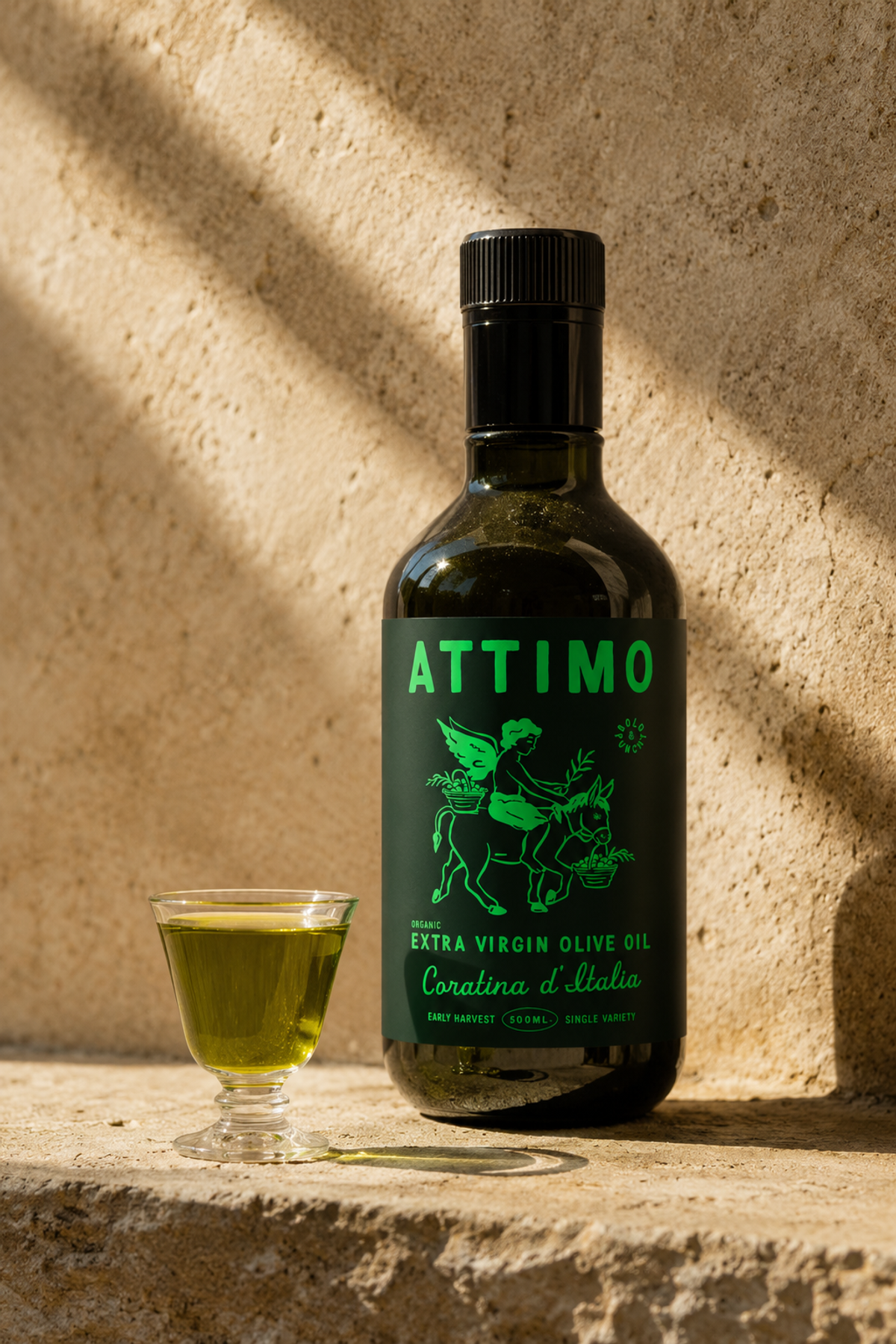
Our 2025/26 Coratina measures 847 mg/kg total biophenols, tested by Chemiservice in Monopoli, an ISO/IEC 17025 accredited laboratory, using the COI standard method. Oleocanthal 471 mg/kg, oleacein 336 mg/kg — the compounds the research is built on, broken out individually instead of folded into one total.
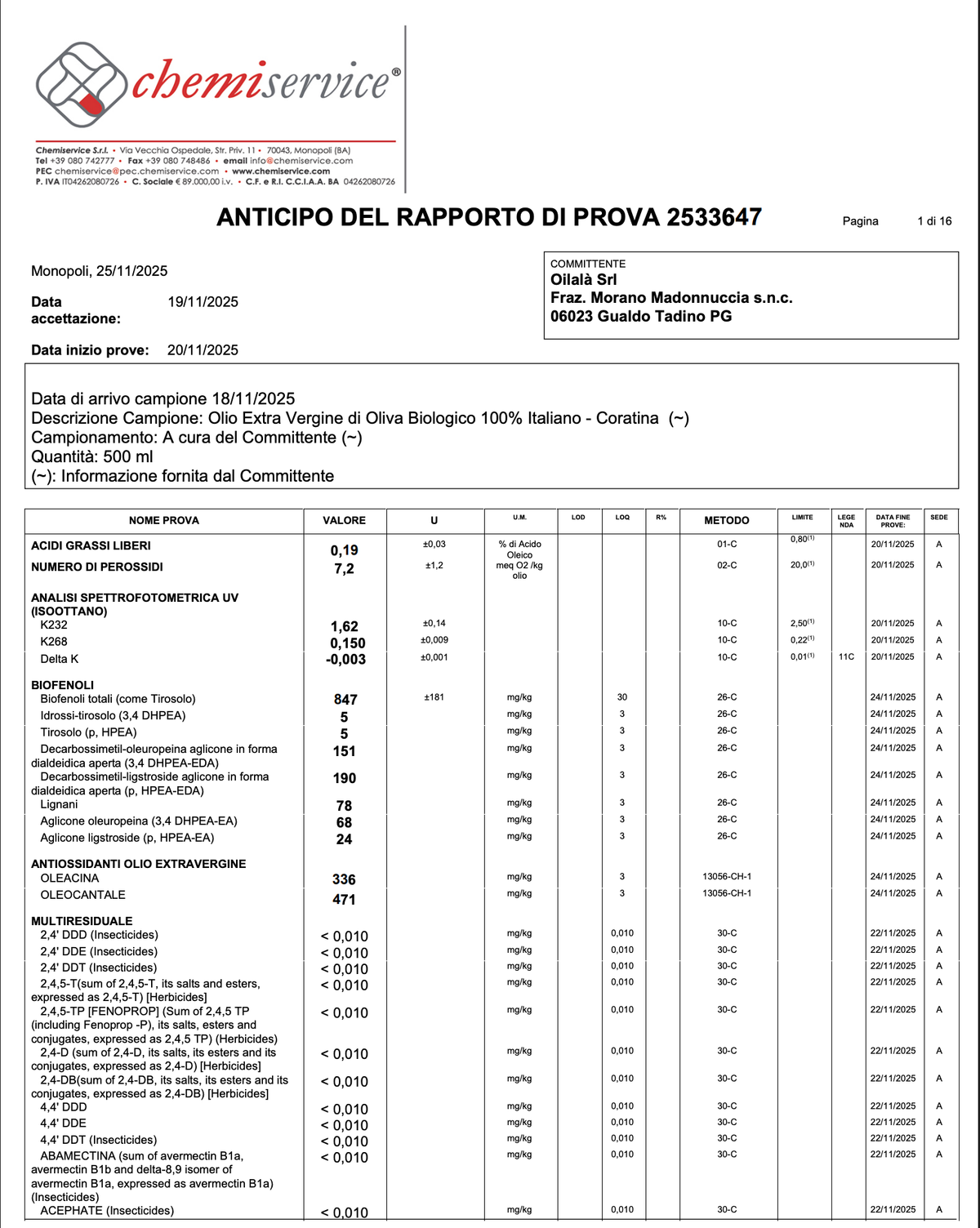
In practice: the 20 g a day the evidence supports, and that the European health claim is built around, is a tablespoon and a half. Around 175 calories. Single variety, early harvest, current crop, numbers published.
You do not need our oil to follow any of this. You need an oil that tells you what is in it and when it was picked, and most will not.
Bryan Johnson drinks three tablespoons. The evidence stops at one and a half. The gap between those two numbers is mostly a question of what is dissolved in the oil.
FAQ
How much olive oil per day is optimal?
Benefit in the cohort data shows up around 7 g a day (half a tablespoon) and flattens at approximately 20 g a day (a tablespoon and a half). The European health claim for olive oil polyphenols is built around 20 g daily. Beyond roughly 20 g, the evidence shows no further risk reduction.
Is 2 tablespoons of olive oil a day too much?
Two tablespoons is about 27 g and roughly 240 calories, slightly above the point where measured benefit plateaus. It is a common intake with no evidence of harm at that level. Whether it is too much depends on whether those calories replace other fats or stack on top of them.
Is 3 tablespoons a day safe?
No study has found harm at that intake, and no cohort has measured it either — it sits above the range the research covers. The binding constraint is calories rather than safety. Three tablespoons is about 360 calories, and Bryan Johnson accommodates them by making olive oil roughly 40% of his total fat inside a restricted budget.
Will drinking olive oil every day make me gain weight?
Added to your existing diet, roughly 360 calories a day will do that over time. Substituted for other fats, the evidence points the other way: a 2025 analysis of 121,119 people found each additional half tablespoon a day tracked slightly less weight gain over four years, and PREDIMED found no significant weight gain from adding around 50 g daily for five years without calorie restriction.
How many calories are in a tablespoon of olive oil?
About 120 per tablespoon (roughly 13.7 g). Three tablespoons is about 360 calories. Bryan Johnson's stated 45 mL works out at about 363.
Should I take it in the morning or on an empty stomach?
No research shows timing matters. Blueprint's own guidance states this directly: timing and food pairing do not appear to matter, and there is no evidence that an empty-stomach morning shot increases the benefit. Consistency is the variable that counts.
Does polyphenol content change how much I need?
Yes, and most guidance leaves it out. Polyphenol concentration varies roughly tenfold between oils. An oil at 850 mg/kg delivers the same polyphenol dose in about a quarter of the volume, and a quarter of the calories, as one at 200 mg/kg.
Is supermarket olive oil as good?
For cooking, often fine. For a daily polyphenol dose, usually not. Most supermarket extra virgin oils measure below 200 mg/kg, blend varieties and harvests, and carry no harvest date. The volume you would need to reach a meaningful dose becomes the problem.
Do polyphenols degrade in the bottle?
Yes. Light, oxygen, heat and time all reduce polyphenol content. A number measured at pressing does not describe the same oil eighteen months later, which is why a harvest date matters more than a best-before date.
What should I stop eating to make room for it?
The fats the research compared against: butter, margarine, mayonnaise, dairy fat, and the refined seed oils used in cooking and dressings. Those substitutions are where the measured mortality benefit came from.
Sources
- Guasch-Ferré M, et al. Consumption of Olive Oil and Risk of Total and Cause-Specific Mortality Among U.S. Adults. J Am Coll Cardiol. 2022;79(2):101–112. https://doi.org/10.1016/j.jacc.2021.10.041
- Xia M, et al. Olive oil consumption and risk of cardiovascular disease and all-cause mortality: a meta-analysis of prospective cohort studies. Front Nutr. 2022;9:1041203. https://doi.org/10.3389/fnut.2022.1041203
- Martínez-González MA, et al. Effect of olive oil consumption on cardiovascular disease, cancer, type 2 diabetes, and all-cause mortality. Clin Nutr. 2022;41(12):2659–2682. https://doi.org/10.1016/j.clnu.2022.10.001
- Estruch R, et al. Primary Prevention of Cardiovascular Disease with a Mediterranean Diet Supplemented with Extra-Virgin Olive Oil or Nuts. N Engl J Med. 2018;378(25):e34. https://doi.org/10.1056/NEJMoa1800389
- Estruch R, et al. Effect of a high-fat Mediterranean diet on bodyweight and waist circumference. Lancet Diabetes Endocrinol. 2019;7(5):e6–e17. https://doi.org/10.1016/S2213-8587(19)30074-9
- Guasch-Ferré M, et al. Changes in olive oil consumption and long-term body weight changes in 3 United States prospective cohort studies. Am J Clin Nutr. 2025;121(5):1149–1156. https://doi.org/10.1016/j.ajcnut.2025.02.012
- Covas MI, et al. The effect of polyphenols in olive oil on heart disease risk factors: a randomized trial. Ann Intern Med. 2006;145(5):333–341. https://doi.org/10.7326/0003-4819-145-5-200609050-00006
- Commission Regulation (EU) No 432/2012, authorised health claims. https://eur-lex.europa.eu/legal-content/EN/TXT/?uri=CELEX:32012R0432