The Olive Oil Polyphenol Index: Every Brand That Publishes Its Polyphenol Numbers (2025/26 Harvest)
Almost no olive oil producer tells you how many polyphenols are in the bottle. This page lists every brand we found that does: the published figures, the compounds behind them, the analysis method, and whether the lab report is open for anyone to check.
Full disclosure: we make olive oil ourselves, and our Coratina is in the index. The ranking method and inclusion rules are public and checkable, and every entry links to its source.
This post is the 2025/26 harvest edition, written up once. The living version is the Olive Oil Polyphenol Index page, rebuilt for 2026/27 as soon as the new analyses are published and updated whenever a producer publishes or submits one. When the numbers below and the page disagree, the page is current.
TL;DR
- Polyphenols are the compounds behind olive oil's bitterness, pungency and most of its researched health effects. Typical supermarket oil carries 100–250 mg/kg; the top oils here carry ten times that.
- We found fifteen producers worldwide that publish polyphenol figures for their current oil, from Greece, Italy, Spain, the Netherlands, Morocco, Germany and the US. This post lists them all.
- Totals from different lab methods are different currencies — the same oil tests at 874 on one method and 1,046 on another — so this index does not rank by total.
- The ranking uses the two documented compounds instead: oleocanthal + oleacein, the "D1 index" printed on University of Athens certificates and used by the high-phenolic world's own awards.
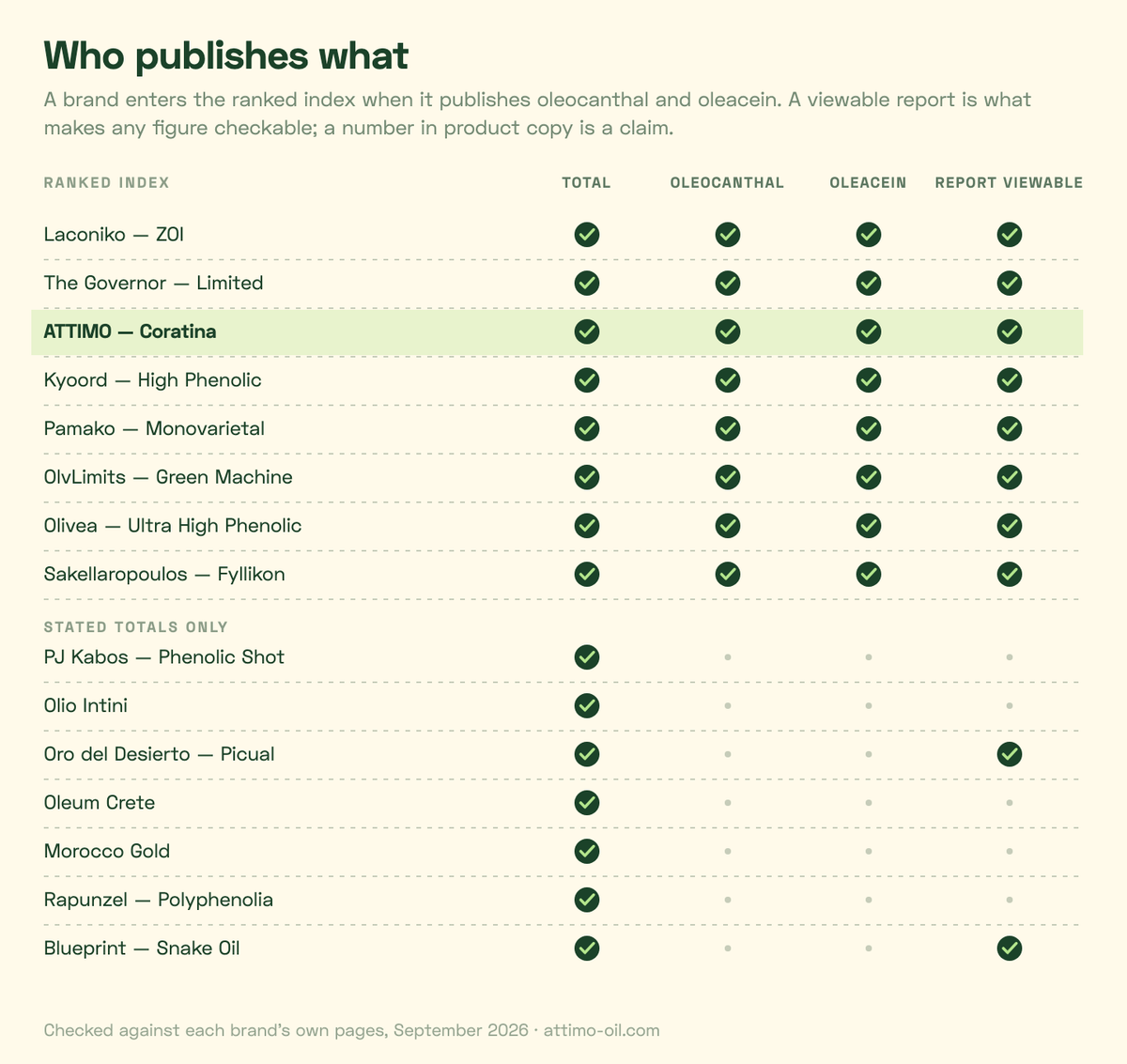
- Oils whose producers publish no compound values appear in a second, unranked list. A stated total alone cannot place an oil.
- The index is alive: producers who publish their analysis can submit it at the bottom of this page.
The inclusion rules
Three rules decide who is in:
- The figures are published by the producer, on the producer's own site. Retailer listings and award registries don't count.
- The figures describe the current or previous harvest. Polyphenols decline as oil ages — a number from 2022 describes an oil that no longer exists.
- Any accredited analysis method qualifies. The method is printed next to every number.
Everything below was verified on the producers' own pages in September 2026.
How the ranking works
Ranking oils by their total polyphenol figure would be the natural thing to do, but it would be misleading.
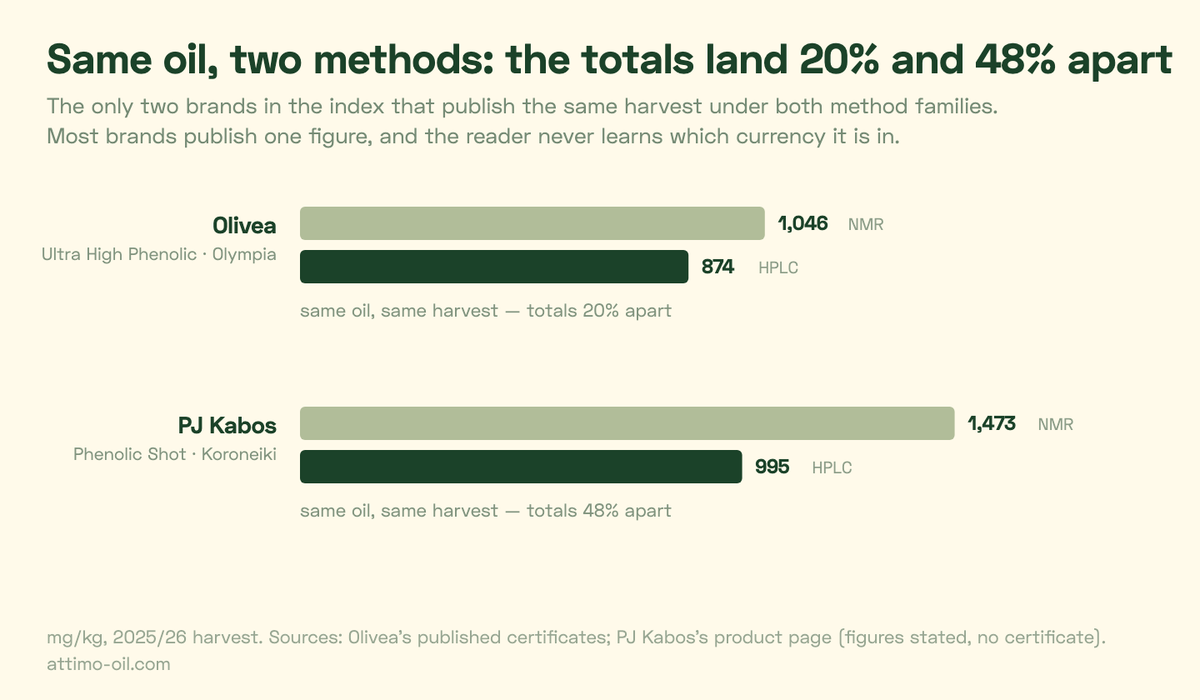
The totals come from different lab methods that count different compound sets in different units: in the published cases where the same oil was analysed by both families, the NMR total came out 20% and 48% above the chromatography total. Two brands below prove it on their own bottles.
The ranked index therefore uses the measure the high-phenolic field itself prefers to use: oleocanthal + oleacein, the two most-researched compounds in olive oil, printed as the "D1 index" on every University of Athens certificate and used by the Aristoleo Awards to grade high-phenolic oils. Unlike total polyphenol counts, these two single named molecules hold up across labs: in peer-reviewed testing on the same oils, oleocanthal measured by NMR and by calibrated HPLC agreed within ±10% (Molecules, 2021). The methods disagree about what a "total" is; they largely agree about a named molecule.
The consequence: an oil can only be ranked if its producer publishes the compound values. Producers who state a total and nothing else appear in the unranked list below the index, whatever the size of the total. A claim you can't verify can't outrank one you can.
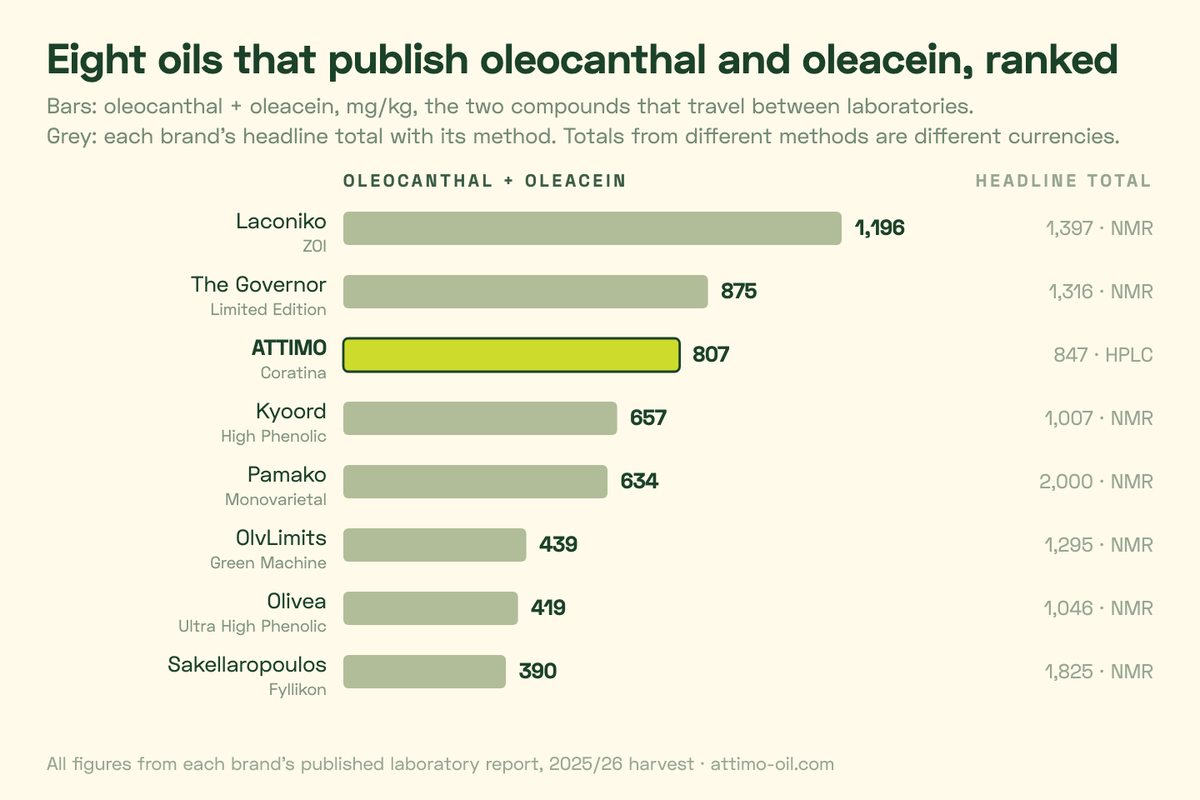
The index, ranked by documented compounds
1. Laconiko — ZOI (Kalamon, Greece) — oleocanthal + oleacein 1,196 mg/kg · total 1,397 (NMR)
- Oleocanthal: 1,000 mg/kg · Oleacein: 195 mg/kg
- Lab report: viewable — COA PDF
- Harvest: September 2025 (2025/26) · Price: $59.95 / 375ml (≈ $80 per 500ml) — currently sold out
The most striking compound figure in this index: oleocanthal at roughly seven times the average oil, documented, and enough for first place on its own. Greek-grown, US-sold, and regularly sold out.
2. The Governor — Limited Edition (Corfu) — oleocanthal + oleacein 875 mg/kg · total 1,316 (NMR)
- Oleocanthal: 577 mg/kg · Oleacein: 298 mg/kg
- Also in range: Premium at 771 combined (476 + 295), total 1,174
- Lab report: viewable — COA download on the Premium product page
- Harvest: October 2025 (2025/26), both grades · Price: £49.95 (Limited) / £39.95 (Premium) per 500ml — both on backorder at the time of writing
Corfiot Lianolia with the strongest fully documented compound pair in the index, in both grades.
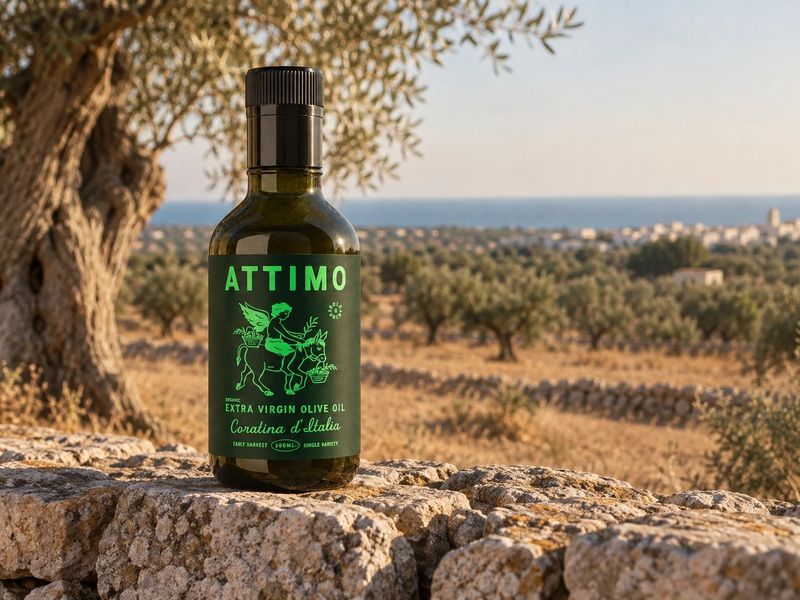
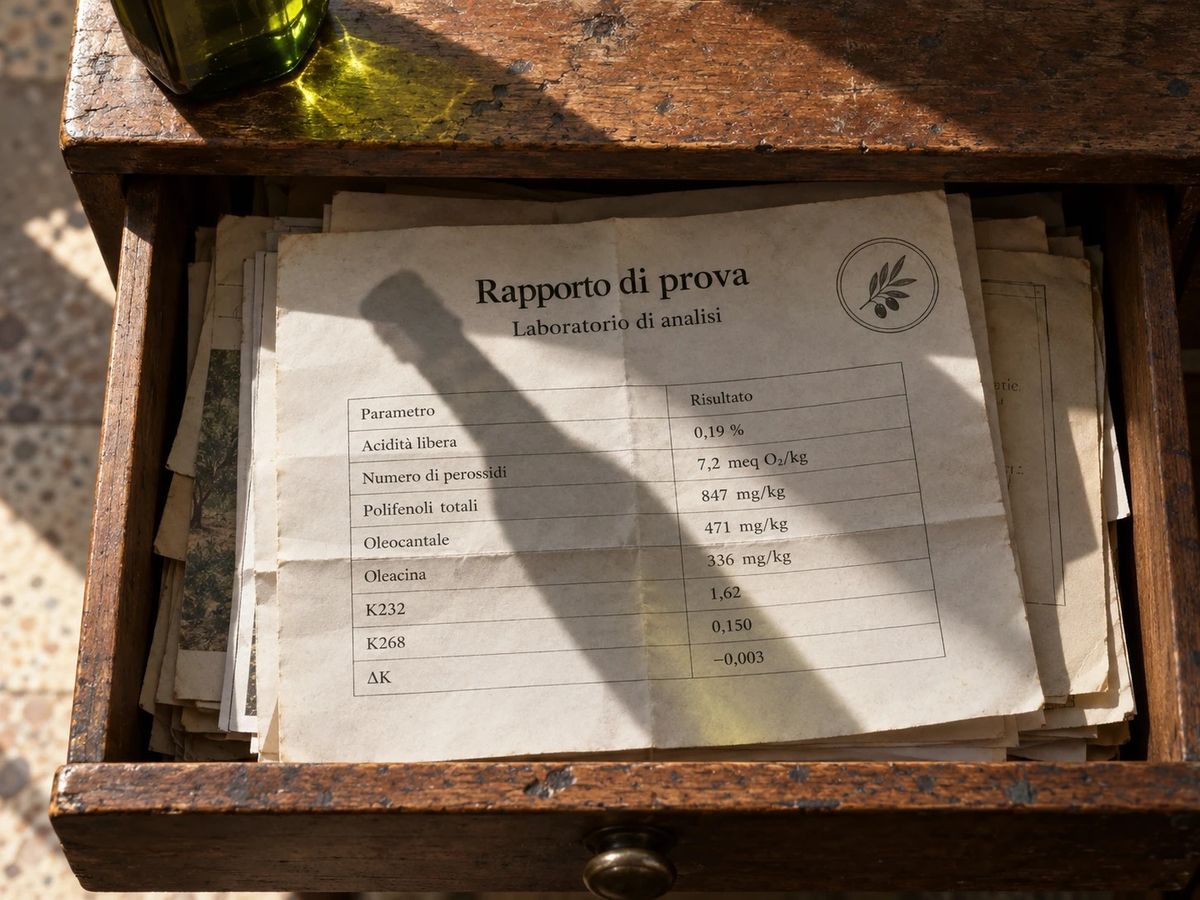
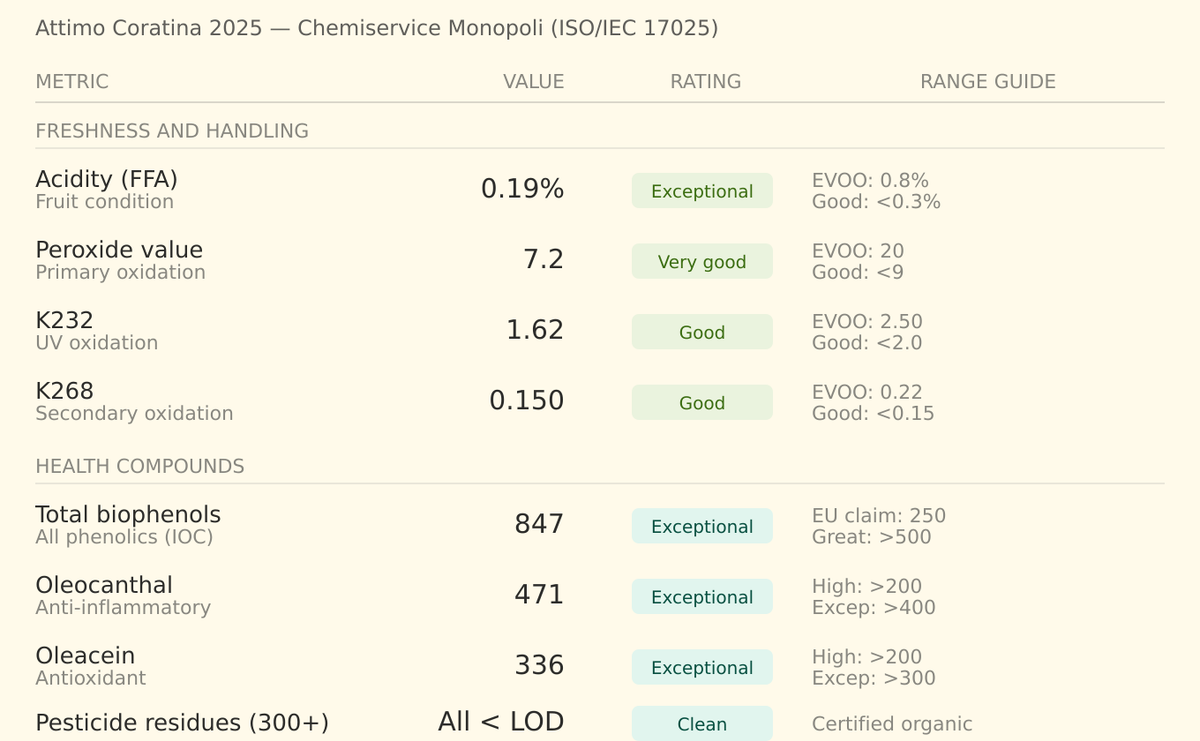
3. ATTIMO — Coratina (Puglia) — oleocanthal + oleacein 807 mg/kg · total 847 (COI)
- Oleocanthal: 471 mg/kg · Oleacein: 336 mg/kg
- Lab report: viewable — COA from an ISO 17025 accredited lab on its certificate page
- Harvest: October 2025 · Price: €24 / 500ml
Our own oil, held to the same format as everyone else's. One method note, because we would write it about anyone: these values come from the chromatography family, which in the one published same-oil comparison (see Olivea below) read oleocanthal well below NMR — so this row is measured by the conservative method, not flattered by it.
4. Kyoord — High Phenolic (Lianolia, Corfu) — oleocanthal + oleacein 657 mg/kg · total 1,007 (NMR)
- Oleocanthal: 374 mg/kg · Oleacein: 283 mg/kg
- Lab report: viewable — University of Athens COA behind the "Third Party Verified Certificate" button on the product page
- Harvest: November 2025 · Price: $49 / 500ml
A US brand pressing Corfiot Lianolia, with compound values ahead of oils carrying much larger totals.
5. Pamako — Monovarietal (Tsounati, Crete) — oleocanthal + oleacein 634 mg/kg · total 2,000 (NMR)
- Oleocanthal: 372 mg/kg · Oleacein: 262 mg/kg
- Lab report: viewable — COA PDF
- Harvest: 2024/25 · Price: not listed by the producer (retailers around €33 / 500ml)
The largest total in the index — and the clearest demonstration of why this page doesn't rank by totals: the 2,000 rides mostly on other derivative compounds, while the two headline molecules sit mid-field. High-altitude organic Tsounati, certified by the World Olive Center for Health.
6. OlvLimits — Green Machine (Coratina, Puglia) — oleocanthal + oleacein 439 mg/kg · total 1,295 (NMR)
- Oleocanthal: 292 mg/kg · Oleacein: 148 mg/kg
- Lab report: viewable — University of Athens COA behind the "Polyphenols Report" button on the product page
- Harvest: October 2025 · Price: €23 / 500ml
A Dutch brand bottling early-harvest Puglian Coratina: a four-figure total with the two headline compounds at roughly a third of it.
7. Olivea — Ultra High Phenolic (Olympia variety, Messinia) — oleocanthal + oleacein 419 mg/kg · total 1,046 (NMR) / 874 (HPLC)
- Oleocanthal: 244 mg/kg · Oleacein: 175 mg/kg (NMR certificate); the HPLC certificate reports the total only
- Lab report: viewable — the NMR certificate (World Olive Center, C2526-00538) is shown and the HPLC certificate (Multichrom, P-127805) linked on a dedicated lab results page
- Harvest: October 2025 · Price: $45 / 500ml
The most instructive entry on the page: the same oil, analysed by both method families, both documents published. The totals land 20% apart — 874 in tyrosol equivalents by the IOC method, 1,046 by NMR. If you read one entry to understand why cross-method comparison needs care, read this one.
8. Sakellaropoulos — Fyllikon First Harvest (Koroneiki, Sparta) — oleocanthal + oleacein 390 mg/kg · total 1,825 (NMR)
- Oleocanthal: 226 mg/kg · Oleacein: 165 mg/kg
- Lab report: viewable — public analysis archive with certificates back to 2010
- Harvest: 2025/26 · Price: not listed (telephone orders and resellers)
The deepest publication record in olive oil: certificates for every product, every year, for sixteen years. The second-largest total in the index, built mostly on compounds other than the headline pair.
Stated totals only — unranked
These producers publish a total but no compound values, so they cannot be placed on the index. Listed by stated figure, which — worth repeating — is not a ranking:
PJ Kabos — Phenolic Shot (Peloponnese) — 1,473 (NMR) / 995 (HPLC) mg/kg
- Oleocanthal: not published · Oleacein: not published
- Lab report: none published — both figures and methods named in product copy only
- Harvest: 2025/26 · Price: €59.83 / 500ml — currently sold out
The other dual-method publisher, 48% apart on the same oil — but with no document and no compounds behind either figure.
Olio Intini (Coratina, Puglia) — 1,100 mg/kg (method not stated)
- Oleocanthal: not published · Oleacein: not published
- Lab report: none published — figure stated in the mill's own writing, covering three oils collectively
- Harvest: 2025 (stated as new harvest) · Price: €24.50 / 500ml
A respected Puglian mill, and the thinnest four-figure claim on this page: no method, no document, no compounds.
Oro del Desierto (Almería, Spain) — 844 mg/kg, Picual (Folin-Ciocalteu)
- Oleocanthal: not published · Oleacein: not published
- Lab report: viewable — analyses for all five varieties, three campaigns of history kept online
- Harvest: 2025/26 · Price: €14.50 / 500ml — the cheapest oil on this page
The most systematic publisher outside the ranked index: the whole range (Picual 844 down to Lechín 507), every campaign, with the method's limitations stated by the producer itself. Folin measures no individual compounds, so a compound ranking is off the table by construction.
Oleum Crete (Koroneiki, Messara) — 800+ mg/kg (method not disclosed)
- Oleocanthal: not published · Oleacein: not published
- Lab report: none published — "800+" runs as a banner claim on the site, while PDO, organic and food-safety certificates are all viewable
- Harvest: not stated · Price: AED 120–210 across three 500ml oils
The certificates it does show make the missing one more visible.
Morocco Gold (Picholine Marocaine) — 606 mg/kg (method not stated)
- Oleocanthal: not published · Oleacein: not published
- Lab report: none published — and the brand's own pages disagree: the shop page says 606 "highest to date", its analysis page shows a recent harvest at 278
- Harvest: not stated · Price: $44.40 / 500ml
Testing labs are named (ONSSA, Campden BRI); the method is not. Both figures are theirs; we list both.
Rapunzel — Polyphenolia (Crete) — 500 mg/kg (method not stated)
- Oleocanthal: not published · Oleacein: not published
- Lab report: none published — figure stated on the shop page
- Harvest: not stated · Price: €9.99 / 250ml (≈ €20 per 500ml)
The one supermarket-channel entry, from a German organic brand. A published number on a retail shelf is rarer than it sounds.
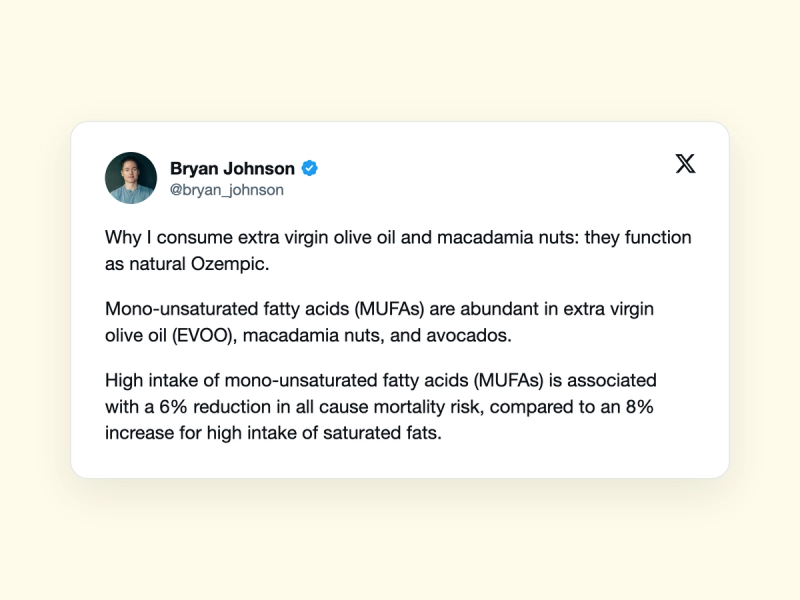
Blueprint — Snake Oil (Bryan Johnson) — 425 mg/kg (HPLC)
- Oleocanthal: not published · Oleacein: not published
- Lab report: viewable — HPLC COA linked from the product page
- Harvest: 2025 analysis · Price: $39 / 750ml (≈ $26 per 500ml)
A modest figure, published with a proper certificate. The document is real; the number is the number. Context on the brand in our Bryan Johnson olive oil breakdown.
The index at a glance
Ranked entries first (by documented oleocanthal + oleacein), then the stated-total-only group.
| Rank | Brand — oil | Oleocanthal + oleacein | Total (mg/kg) | Method | Lab report | Price ≈ 500ml |
|---|---|---|---|---|---|---|
| 1 | Laconiko — ZOI | 1,196 | 1,397 | NMR | viewable | $59.95 / 375ml (sold out) |
| 2 | The Governor — Limited | 875 | 1,316 | NMR | viewable | £49.95 (backorder) |
| 3 | ATTIMO — Coratina | 807 | 847 | COI | viewable | €24 |
| 4 | Kyoord — High Phenolic | 657 | 1,007 | NMR | viewable | $49 |
| 5 | Pamako — Monovarietal | 634 | 2,000 | NMR | viewable | not listed |
| 6 | OlvLimits — Green Machine | 439 | 1,295 | NMR | viewable | €23 |
| 7 | Olivea — Ultra High Phenolic | 419 | 1,046 / 874 | NMR + HPLC | viewable | $45 |
| 8 | Sakellaropoulos — Fyllikon | 390 | 1,825 | NMR | viewable | not listed |
| — | PJ Kabos — Phenolic Shot | not published | 1,473 / 995 | NMR + HPLC | none published | €59.83 (sold out) |
| — | Olio Intini | not published | 1,100 | not stated | none published | €24.50 |
| — | Oro del Desierto — Picual | not published | 844 | Folin-Ciocalteu | viewable | €14.50 |
| — | Oleum Crete | not published | 800+ | not disclosed | none published | AED 120–210 |
| — | Morocco Gold | not published | 606 | not stated | none published | $35.52 (sale, from $44.40) |
| — | Rapunzel — Polyphenolia | not published | 500 | not stated | none published | €9.99–11 / 250ml |
| — | Blueprint — Snake Oil | not published | 425 | HPLC | viewable | $26 / 750ml |
How the labs measure, and why the totals differ
"Total polyphenols" sounds like one measurement. It is at least three, depending on the lab.
NMR (nuclear magnetic resonance) is the method behind most certificates in this index, run by the World Olive Center for Health with the University of Athens. It identifies and sums a long list of individual phenolic compounds, including heavy derivative molecules that other methods partly miss. Because it counts more compounds, its totals read structurally higher.
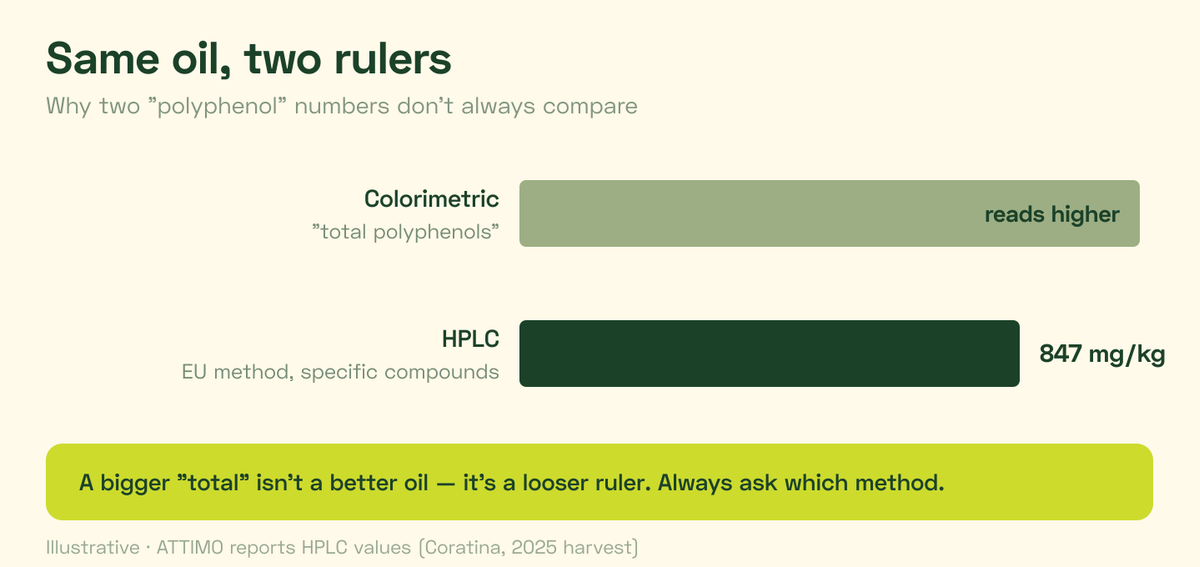
HPLC and the COI reference method are the chromatography methods used by most accredited food labs, including the International Olive Council's official method for biophenols. They quantify a narrower, defined set of compounds, so totals read lower for the same oil.
Folin-Ciocalteu is an older colour-reaction method that estimates total phenolic activity rather than counting compounds, expressed in caffeic acid equivalents — again its own scale.
The gap has structural causes, not sloppy labs. NMR counts the full weight of the large aglycon molecules and captures compounds that degrade or convert inside a chromatography column — the University of Athens group has shown chromatography can create derivative artifacts on-column (J. Agric. Food Chem., 2014). The COI method, in the other direction, expresses its total in tyrosol equivalents: it counts the small core of each molecule, a units convention that reads low by construction. Even within a single COI certificate, the sum of the individually identified compounds can sit well below the stated total. And Folin correlates only loosely with compound-resolved totals — a 2026 study across a hundred top-rated oils found the two disagree on whether an oil clears the EU claim threshold in a third of cases (Antioxidants, 2026).
The gap is also measurable, because two brands above publish the same oil under both families: Olivea reads 874 by HPLC and 1,046 by NMR; PJ Kabos reads 995 and 1,473. Same oil, both numbers legitimate, 20% and 48% apart — and because the gap depends on each oil's phenolic profile, no fixed conversion factor exists. This index converts nobody's number. A projected figure a producer never published has no place in a list built on published figures.
The compounds behave differently. In peer-reviewed testing on the same oils, oleocanthal by NMR and by calibrated HPLC agreed within ±10% (Molecules, 2021): the disagreement between methods lives in the definition of "total", not in the measurement of a named molecule. That is the scientific basis for ranking on compounds. One asymmetry remains — COI certificates state compound lines in their conservative units too, which is why Olivea's oleocanthal reads 143 on the COI certificate and 244 on the NMR one. Chromatography rows in the ranking are understated by that asymmetry, never flattered.
Why almost nobody publishes a number
Polyphenol content is the closest thing olive oil has to a measurable quality signal. It predicts bitterness and pungency, it decides whether an oil qualifies for the EU's only approved olive oil health claim, and it declines with age — a high number implies fresh, carefully handled oil.
Most producers still publish nothing, and the reason is structural: most oil would test poorly. Late-harvest, high-yield production — the economics behind nearly every supermarket bottle — gives oil low in polyphenols. Publishing a number would document that.
The fifteen brands above are a self-selected group. Publishing is itself the signal: it says the producer measured, and was willing to show the result.
Numbers that exist, published by someone else
Some spectacular figures circulate only in award registries or on retailers' pages, with nothing on the producer's own site. They sit outside the index until that changes:
- Sparta Medicinal Olive Oil (D. Sakkas) — 3,400 mg/kg per the World Olive Center's 2026 awards, the highest figure we encountered anywhere.
- Omfakion Plus — 2,006–2,101 mg/kg with oleocanthal up to 1,534, per retailer listings.
- Evolia — around 2,012 mg/kg, per its Aristoleo Triple Gold award and retailer listings.
- PhenOLIV — 2,011 mg/kg, retailer listing only.
- Physis of Crete — Korona — 1,477 mg/kg NMR on a Polish retailer's page; the producer's own site states no figure.
And one entry retired on the freshness rule: Tricarico publishes full analysis scans for its Coratina — from 2022. The oil that document describes is gone.
The brands that publish nothing
For contrast, we checked a set of prominent premium and supermarket brands for any published polyphenol figure. As of September 2026: De Carlo (a celebrated Coratina monocultivar producer whose product page praises "the high value of polyphenols" without stating one), Guglielmi, Castillo de Canena, Biolea, Filippo Berio and Frantoio Muraglia publish no number for any oil.
Terra Creta earns a special mention: enter a lot number on its traceability tool and you get acidity, peroxide value and UV absorbance for your exact bottle. Polyphenols are absent from the parameters.
No published number does not mean a poor oil. It means an unverifiable one. The producers above operate mills, commission analyses and see these figures every season; leaving them unpublished is a choice.
Submit an oil
If you produce an oil that qualifies — polyphenol figures for the current or previous harvest, published on your own site — or you found a brand we missed, send the link and the analysis to hello@attimo-oil.com, or use the submission block on the index page. Entries are verified against the published source and added at the next update. Any accredited lab or university programme qualifies, whichever method it uses; publishing oleocanthal and oleacein places an oil in the ranked index.
FAQ
Which olive oil has the highest polyphenol content?
No single answer is possible across lab methods, which is why this index ranks by documented compounds instead: Laconiko ZOI leads with 1,196 mg/kg oleocanthal + oleacein (1,000 of it oleocanthal), followed by The Governor Limited (875 combined oleocanthal + oleacein) and ATTIMO Coratina (807). The largest published totals are Pamako's 2,000 and Sakellaropoulos Fyllikon's 1,825, both NMR figures. Higher totals exist in award registries — up to 3,400 mg/kg — but their producers publish nothing themselves.
What counts as a high polyphenol content?
The EU's approved health claim requires 5 mg of hydroxytyrosol and derivatives per 20 g of oil — roughly 250 mg/kg total polyphenols. Typical supermarket oil sits at 100–250 mg/kg. Everything in this index clears the claim threshold; the top entries carry around ten times a supermarket bottle.
Why do two labs give the same oil different numbers?
They count different things in different units. NMR sums the full weight of a long list of phenolic compounds; the COI method expresses its total in tyrosol equivalents, which reads low by construction; Folin-Ciocalteu estimates total phenolic activity chemically. Two brands in this index publish the same oil under two methods, 20% and 48% apart. Individual compounds are the exception: measured on the same oils, oleocanthal by NMR and by calibrated HPLC agrees within about 10%.
What are oleocanthal and oleacein?
The two most-researched individual polyphenols in olive oil. Oleocanthal produces the peppery catch at the back of the throat and has documented anti-inflammatory activity; oleacein is an antioxidant studied for cardiovascular protection. Average oils carry roughly 135 and 105 mg/kg respectively, per the UC Davis study referenced on University of Athens certificates.
Does a higher number mean a better oil?
It means a more polyphenol-dense oil, which predicts bitterness, pungency and the researched health effects. It says nothing about defects, freshness at the moment you buy, or whether you'll enjoy the taste — the top oils here are intense experiences. Quality still needs the basics: extra virgin grade, recent harvest, dark packaging.
Why is my favourite brand missing?
Either it publishes no polyphenol figure on its own site — the industry norm — or we missed it. The second has a fix: hello@attimo-oil.com.
How often is this page updated?
At every harvest cycle and whenever a producer submits or updates an analysis. Figures shown were verified on producers' own pages in September 2026.