28 Olive Oil Myths That Won't Die
Olive oil is one of the most written-about foods in the kitchen, and one of the most misunderstood. A lot of what people believe about it is marketing, habit, or a good story that happens to be wrong.
Here are twenty-eight of the most common, grouped by where they come from, and what holds up instead.
TL;DR
- Colour, "cold pressed", price and pretty bottles are unreliable guides to quality. Taste and harvest date are the ones to trust.
- "Extra virgin" is a legal floor, and the range above it is enormous: an oil with 80 mg/kg of polyphenols and one with 800 both qualify.
- "Product of Italy" often means bottled in Italy, from olives grown anywhere.
- Olive oil is fruit juice. It starts losing aroma and polyphenols the day it's pressed, so a distant best-before date means nothing — it's counted from bottling, which can happen years after the harvest.
- The harvest date is the honest date, and in the EU a printed harvest date legally guarantees every drop comes from that harvest. That's why cheap oil doesn't print one.
- Unfiltered oil degrades faster, the fridge does more harm than good, and the shelf next to the stove is the worst spot in the kitchen.
- You can cook with extra-virgin olive oil. It's more heat-stable than its reputation.
- The health value varies several-fold between bottles. Polyphenols are the difference, and only a lab report can tell you the number.
- Outright fake oil is rarer than the headlines suggest. Old oil sold as fresh is the real epidemic, and no kitchen trick can detect either.
Judging by looks
Myth 1: "The greener the oil, the higher the quality."
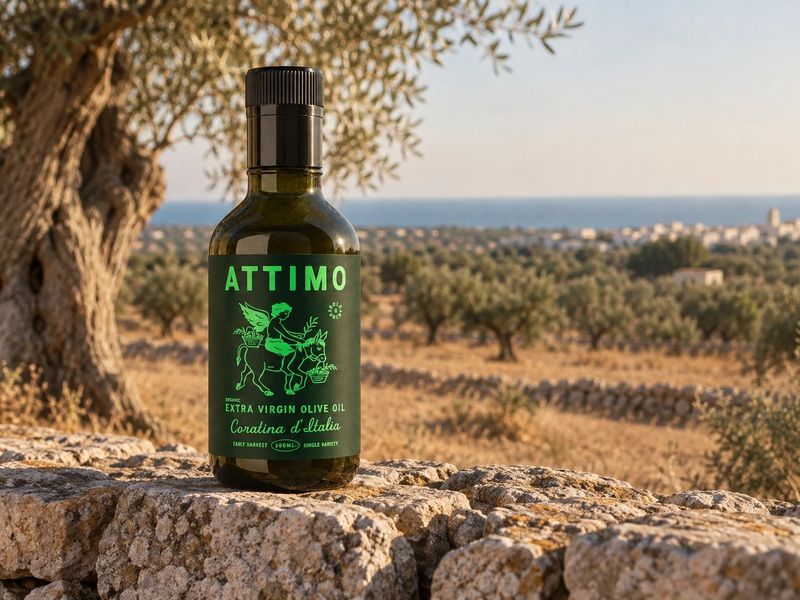
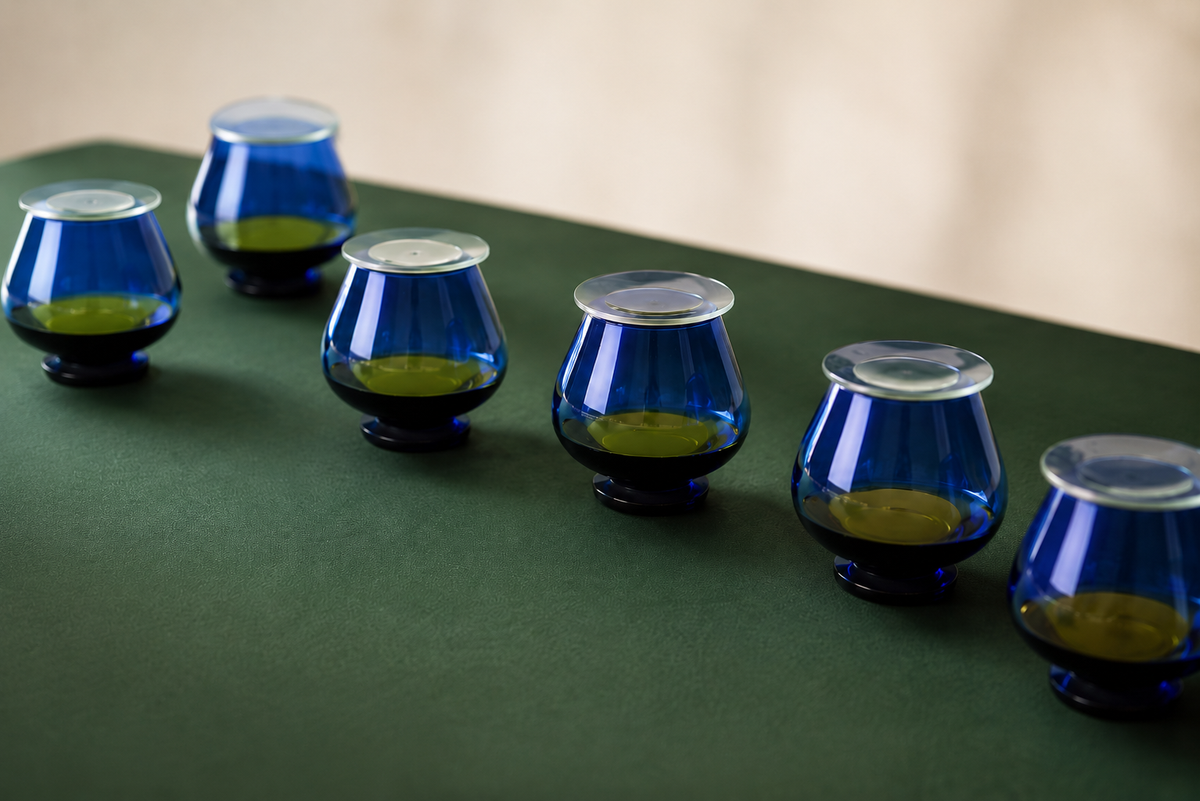
A deep green oil looks premium and a pale golden one looks cheap, so colour feels like a quality signal. And there's truth in it: greener oil can indicate younger olives, and younger olives give oil with more polyphenols and flavour. But colour varies widely per cultivar and is easily faked: an early-harvest Arbequina presses gold, a Coratina deep green, and milling a few extra leaves makes any oil greener. That's why professional tasters use blue glasses: the tint hides the oil's colour, so it can't bias their judgment. Go by taste and by the harvest date. What colour does tell you, we've unpacked here.
Myth 2: "Cloudy, unfiltered oil is more natural, so it's better."
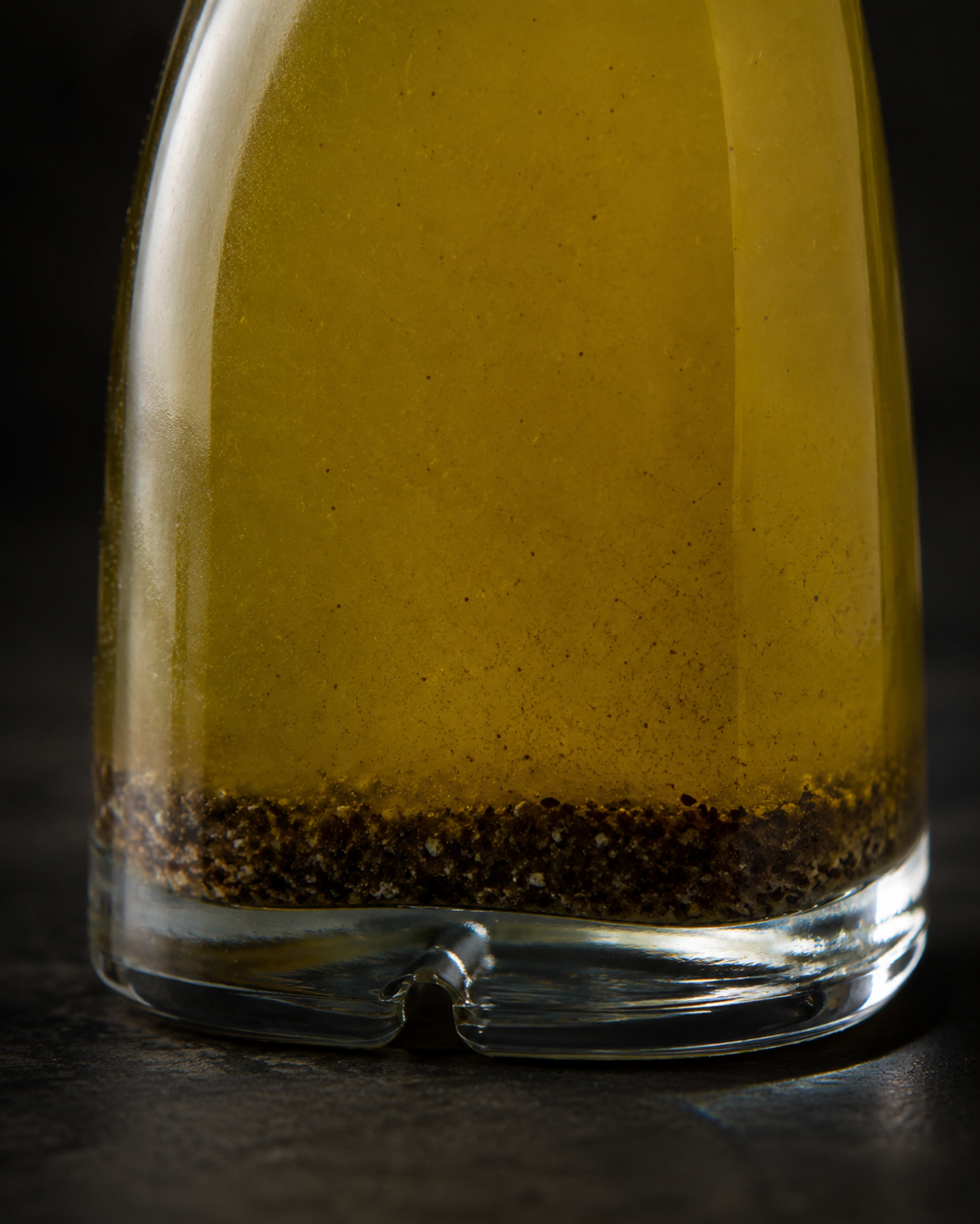
Unfiltered oil looks less processed, and the instinct makes sense: think raw honey, or natural wine. With olive oil it works against you. The leftover water and fruit particles that make it cloudy speed up oxidation, so an unfiltered oil loses its polyphenols, the antioxidants behind its flavour and its health value, faster than a filtered one. Filtering is mechanical; it removes water and sediment, not the good stuff. Unless you're eating it within days of pressing, filtered keeps better.
Myth 3: "A higher price means a better oil."
Good oil is rarely cheap: early harvest sacrifices yield, and a single variety can't be stretched with filler. But the reverse doesn't hold. A heavy bottle, an origin story and a €25 price tag are cheap to produce; plenty of expensive oil is mediocre. Price narrows the field. The harvest date and the taste settle it.
Myth 4: "A medal or a beautiful bottle means better oil."
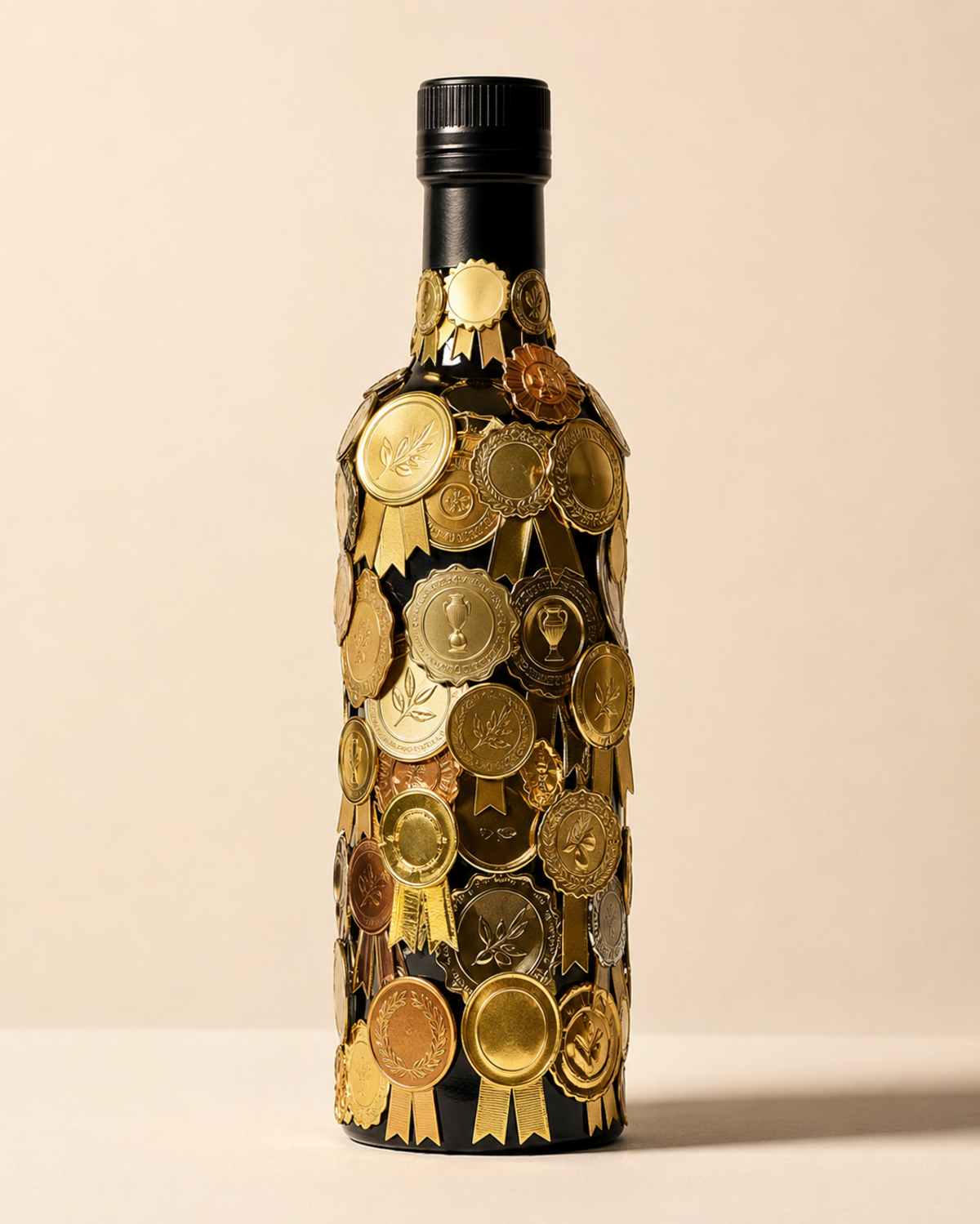
Some competitions are serious. Many are pay-to-enter operations where most entries win something, because entry fees are the business model. The bottle was designed by whoever the producer hired; the oil was made months earlier, in the grove. Look past both to the details that carry information: harvest date, named variety, and from the serious producers, a lab-tested polyphenol count.
What the labels mean
Myth 5: "'Extra virgin' is a guarantee of quality."
"Extra virgin" is more a legal category than a quality marker: mechanical extraction, acidity below 0.8%, no defects a tasting panel can find. That's the floor for even considering an olive oil. An oil with 80 mg/kg of polyphenols and an oil with 800 both clear it — above the floor, quality still varies widely.
Myth 6: "'Cold pressed' means premium."
"Cold pressed" sounds special but says nothing. By law, extra virgin is already extracted without heat, so the phrase comes with every bottle that carries the grade. The term itself is a leftover from the stone-mill days; today everything is spun in a centrifuge under the same temperature limit.
Myth 7: "Virgin and extra virgin are the same thing."
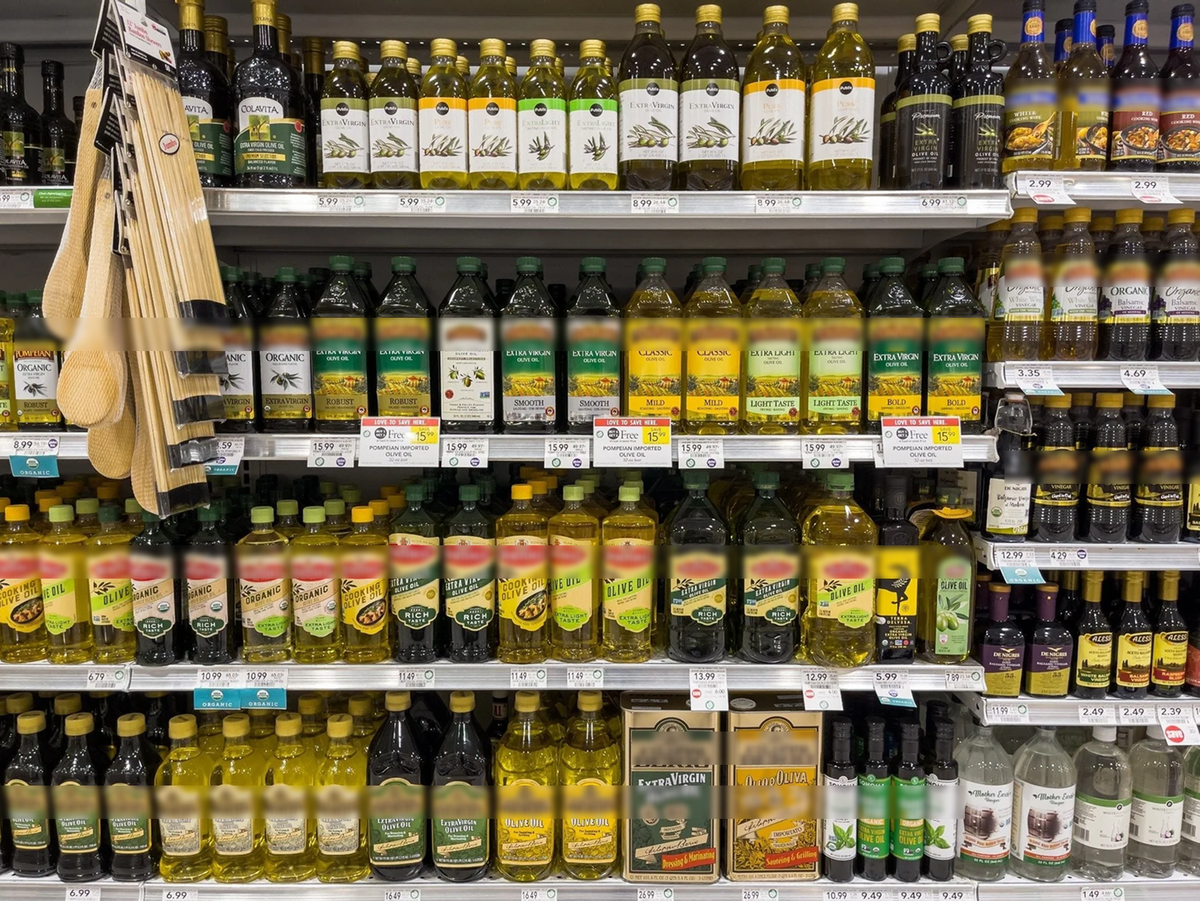
They're neighbouring grades on the same ladder. Virgin allows higher acidity and mild taste defects that would disqualify an extra virgin. In practice you rarely see plain "virgin" on a shelf; what stands next to extra virgin in the supermarket is usually refined oil under friendlier names, and that is a much bigger step down than one word suggests.
Myth 8: "'Pure' and 'light' olive oil are the cleaner choice."
Both are refined oil: stripped with heat and solvents until almost nothing of the olive remains, then topped up with a splash of virgin oil for colour. "Light" refers to the flavour; the calories are identical, because it is all fat. The polyphenols are gone. When those words are on the front, the interesting part of the olive never made it into the bottle.
Myth 9: "'Product of Italy' means Italian olives."
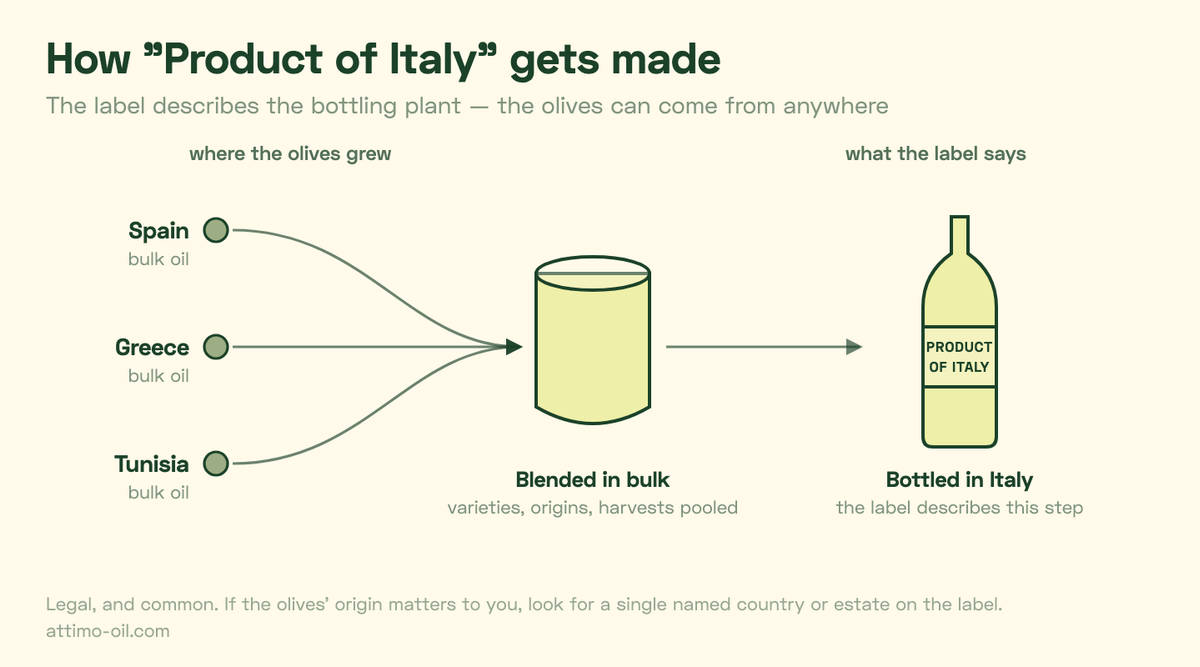
Italy is a byword for good oil, so the phrase sells. Often it means only that the oil was bottled or blended in Italy, from olives grown across Spain, Greece, Tunisia and elsewhere. If the origin of the olives matters to you, look for a single named country or estate; the packing location isn't the same thing.
Myth 10: "Olive oil blends are lower quality."
Blending itself isn't a problem. In wine it's a craft, different grapes balancing each other, and olive oil can be blended the same way. But big producers mostly blend for cost: cheaper oils mixed in to hit a price. The tell is on the label; a producer blending for flavour names the varieties; a producer blending for cost writes nothing at all.
Myth 11: "Pomace oil is just cheaper olive oil."
After the press, the leftover paste of skins, pits and pulp still holds a few percent of oil. Getting it out takes solvents and high heat, followed by refining to make it edible. That process has more in common with seed-oil production than with anything a mill does. It's legal and it's cheap; it just isn't what anyone means by olive oil.
Freshness and storage
Myth 12: "Olive oil gets better with time."
It doesn't. Wine has tannins and sugars that keep developing in the bottle; olive oil is pressed fruit juice with nothing left to work with. It's best fresh and only declines with age.
Myth 13: "When the olives are picked makes no difference."
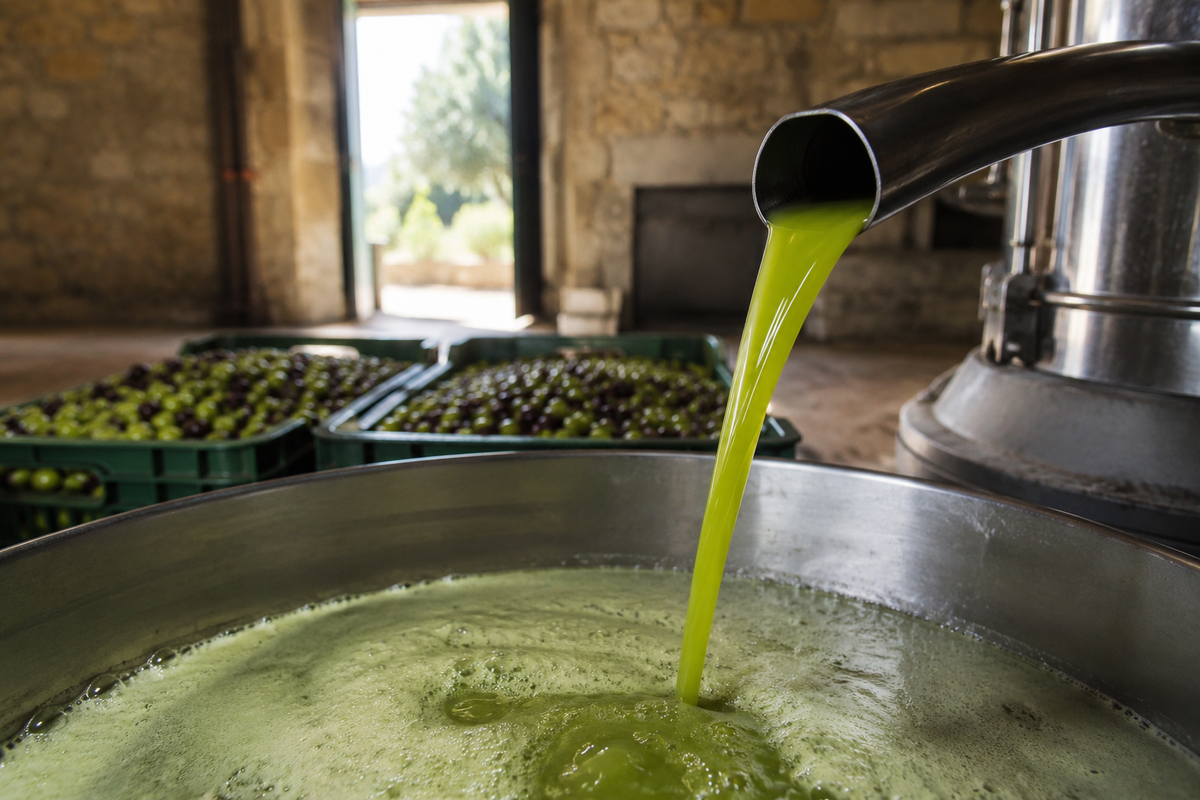
There is one harvest a year, roughly October to January, and the picking week matters. Early, green olives give less oil but more polyphenols and flavour; late olives give more oil with less of both. Supermarket producers prefer late harvest because it gives more oil for less money (but they won't put this on the label).
Myth 14: "A long best-before date means it's fresh."
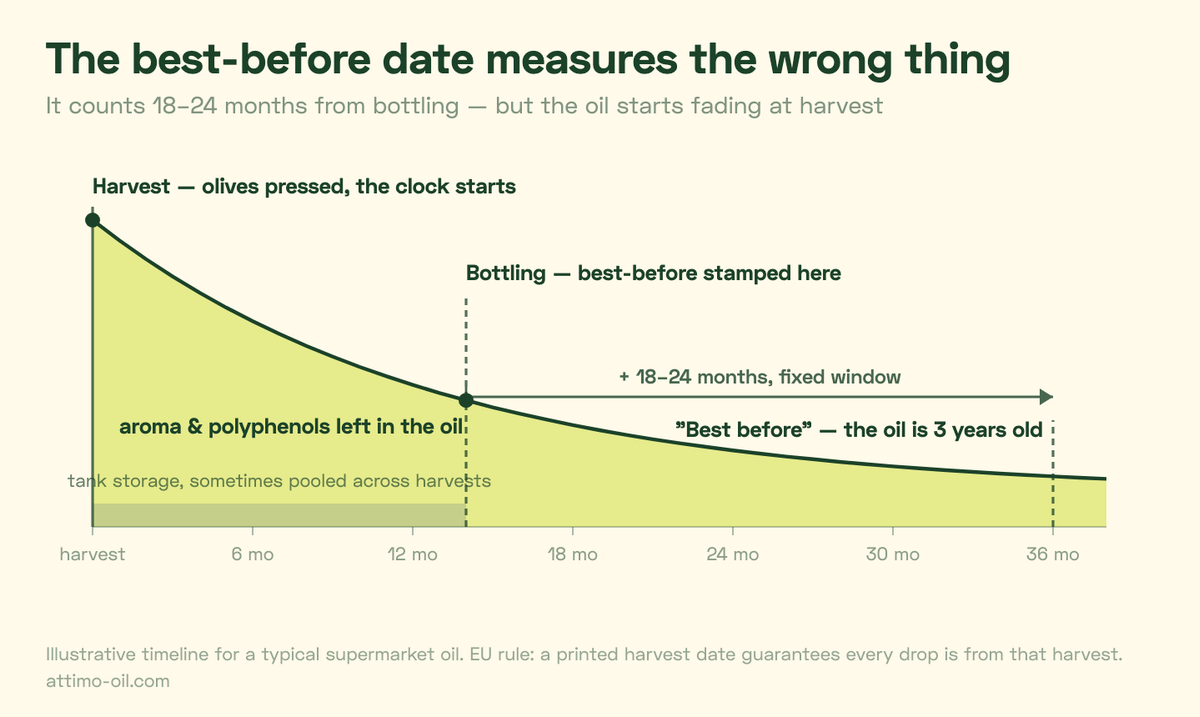
A date far in the future feels reassuring, but here's the catch: the best-before is counted from the bottling date. It says nothing about the oil's freshness. Producers just add a fixed window, usually 18 to 24 months, to the day they bottle. And bottling can happen long after pressing, or pool several harvests, so a bottle can carry a comfortable best-before while the oil inside is already old. Olive oil is fruit juice; it fades from the day it's pressed. The date that tracks that is the harvest date, and cheap oil usually doesn't print one. The EU gives the game away here: a producer who prints a harvest date must guarantee that every drop in the bottle comes from that harvest. That is exactly why bulk blenders leave it off.
Myth 15: "Unopened, it keeps for years."
The seal slows the decay without stopping it. Light and residual oxygen keep working through the months, and after a year and a half much of what made the oil worth buying has already gone. Buy from the most recent harvest, in bottles you'll finish.
Myth 16: "Keeping it next to the stove is fine."
Light, oxygen and heat are the three things that degrade oil, and the shelf beside the hob delivers two of them every day, with the cap often loose for the third. A dark cupboard at room temperature is all it asks.
Myth 17: "The fridge keeps it fresh."
Cold doesn't harm the oil directly, but it thickens it into an unpourable sludge, and the in-and-out cycles can draw condensation into the bottle, which does harm it. A dark cupboard achieves the same protection without the drawbacks.
Myth 18: "A plastic bottle is fine for olive oil."
Olive oil has three enemies: light, oxygen and heat. A plastic bottle lets oxygen through, and if it's clear it lets light in too; dark glass and tins block both. That's why serious producers prefer them. We took a full look at what packaging does to olive oil.
Cooking and heat
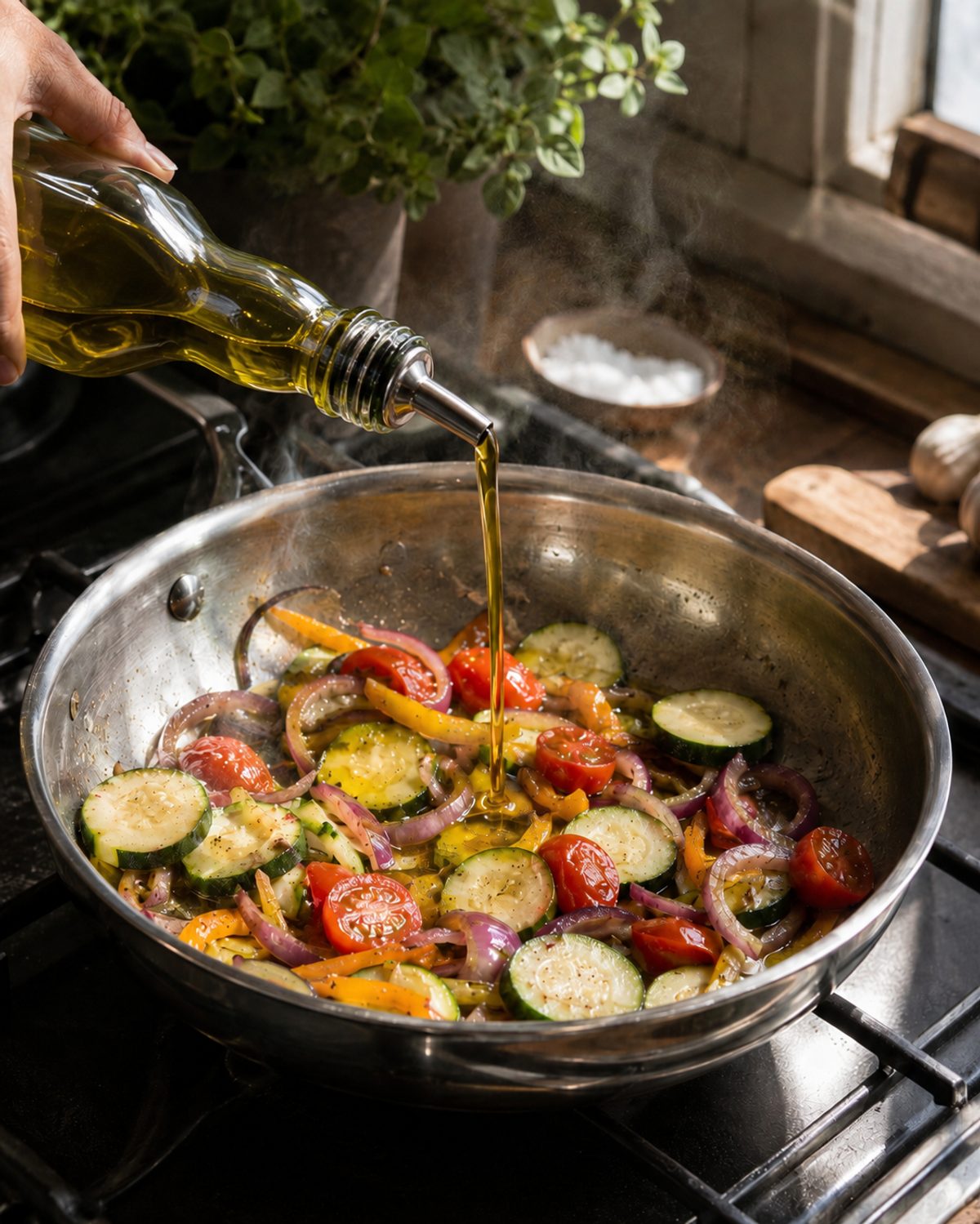
Myth 19: "You shouldn't cook with extra-virgin olive oil."
Extra-virgin smokes at a lower temperature than refined oils, so it gets called unfit for the pan. But smoking and breaking down are different things. What matters is how well an oil resists oxidising under heat, and there extra-virgin does well: its mostly-monounsaturated fat and its polyphenols make it steadier than its reputation. For everyday cooking it's a fine choice. Keep your best, most peppery bottle for finishing, where you lose nothing to the heat.
Myth 20: "Heating olive oil makes it toxic."
The story goes that past its smoke point, the oil turns carcinogenic. In heating studies, extra-virgin is among the most stable oils you can put in a pan: the monounsaturated fat resists oxidation, the polyphenols slow the breakdown further, and at home-cooking temperatures it produces fewer harmful compounds than most seed oils. The scary numbers come from industrial frying, oil held at high heat for days on end.
Myth 21: "Heat destroys all the benefits."
Part of this is true: the aroma is volatile, and a share of the polyphenols does break down in the pan. But the fat itself is unchanged, and a meaningful share of the polyphenols survives ordinary cooking — some even migrate into the food. What you lose is the finish. That's why the peppery bottle belongs on the finished plate, while an everyday extra virgin does the frying.
Health
Myth 22: "All olive oils are equally healthy."
"Olive oil is healthy" gets repeated as though every bottle were the same. Most of that health comes from polyphenols, and their level varies several-fold: a fresh, high-polyphenol olive oil can carry many times more than a low-phenol supermarket one, while refined "light" and "pure" oils have almost none left. Every olive oil is a decent fat. The difference in what it does for you is real.
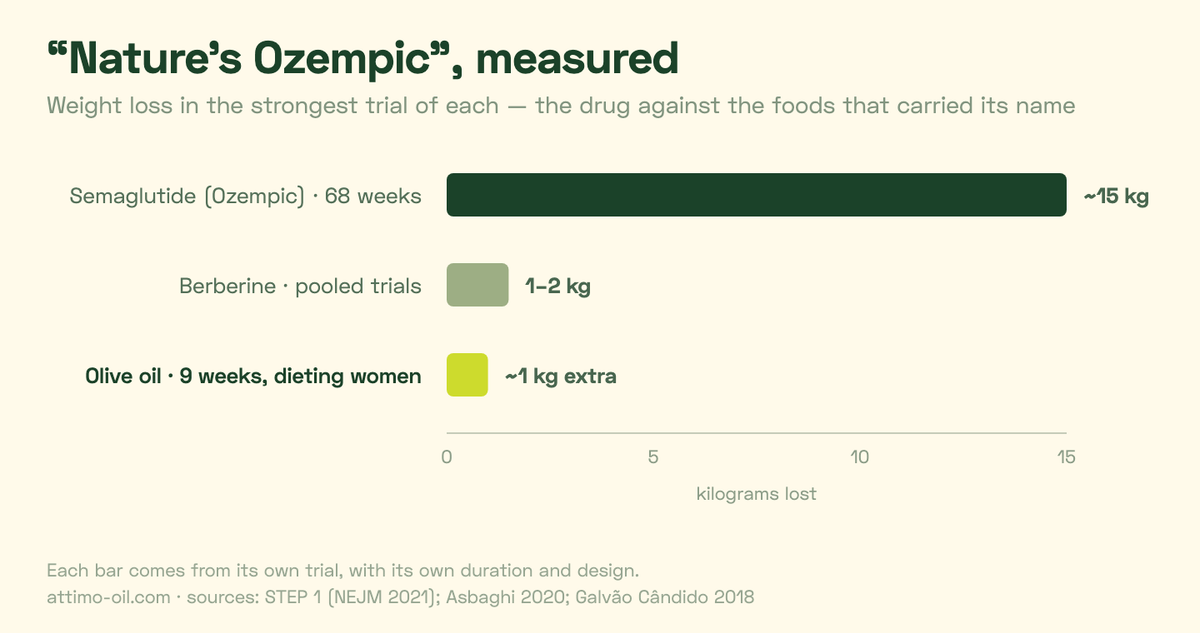
Myth 23: "Olive oil is nature's Ozempic."
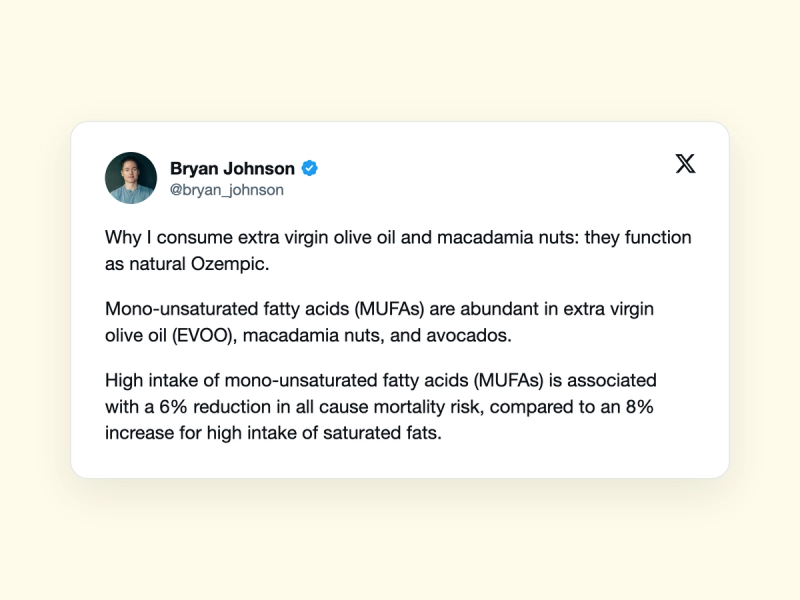
The comparison was tweeted by Bryan Johnson, the longevity influencer who gets roughly 15% of his daily calories from olive oil. There's a grain of truth but it's exaggerated: olive oil nudges the same fullness hormone (GLP-1) the drugs target, keeping you satiated for longer, but at a small fraction of the effect. We've taken the claim apart in detail.
Myth 24: "It's fattening, so go easy."
At nine calories per gram it's as dense as any fat, so the calories are real. But the trials that made olive oil famous are replacement trials: in the Harvard cohort, swapping roughly ten grams a day of butter, margarine or mayonnaise for olive oil tracked with an 8–34% lower mortality risk. Put it where other fat used to be, and the calorie question mostly answers itself. How much per day is its own question.
Myth 25: "A spoonful a day prevents [name a disease]."
European law permits exactly one health claim on an olive oil label, and it's narrow: polyphenols help protect blood lipids from oxidative stress, provided the oil carries enough of them. Everything beyond that — the cancer cures, the miracle-tonic framing — is someone's marketing. The narrow claim is still worth having. Most supermarket oil is too low in polyphenols to qualify for it.
Real and fake
Myth 26: "The fridge test proves it's real."
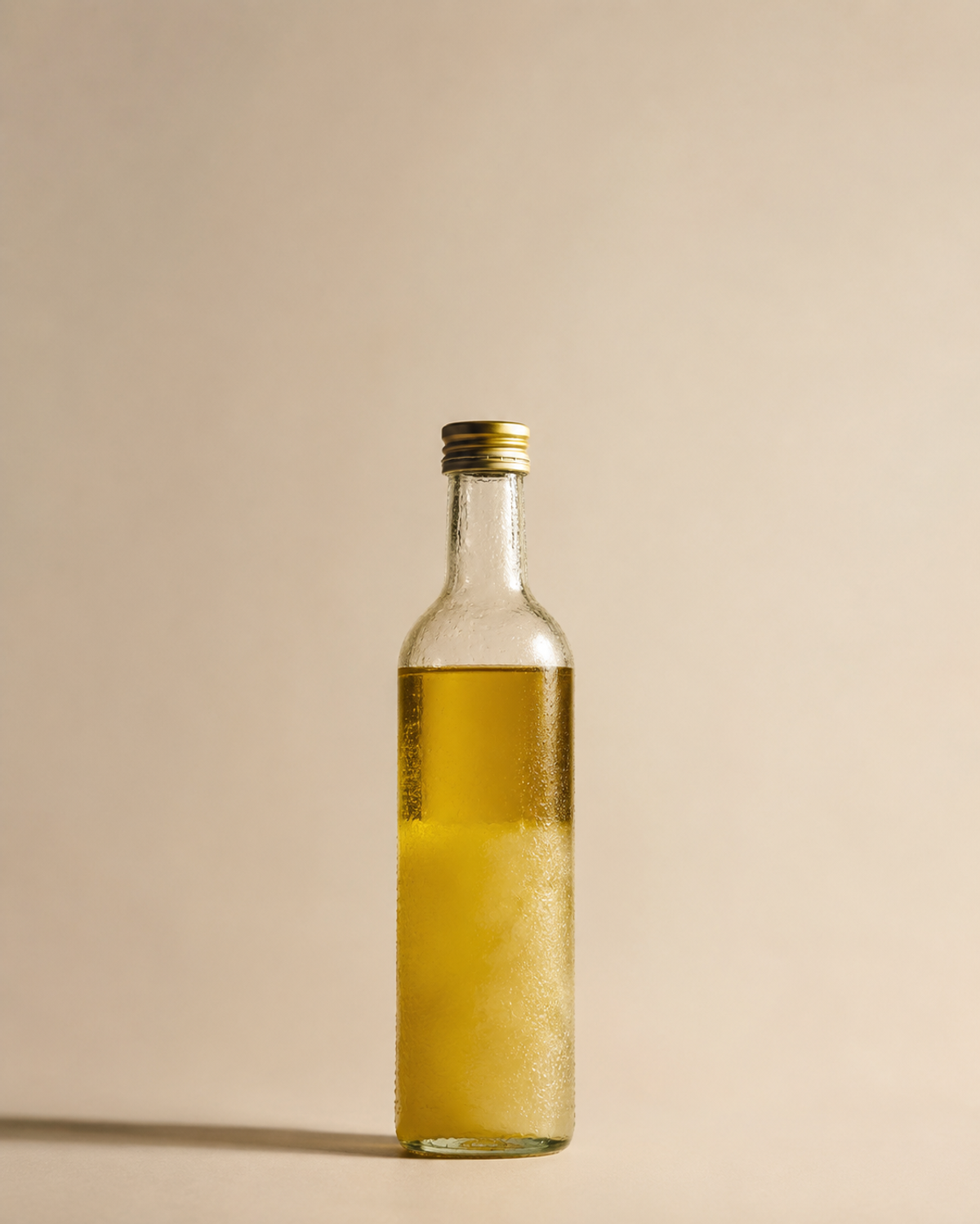
The trick: chill the bottle, and if it turns solid the oil is genuine. Whether an oil sets in the cold comes down to its fat mix and the temperature. Purity has nothing to do with it — real oils vary, some barely thicken, and adulterated ones can solidify too. A fun experiment that proves nothing.
Myth 27: "Most olive oil on shelves is blended with seed oils."
Cutting olive oil with seed oil is fraud, and it's rarer than headlines suggest; cases surface every year, and Italy runs a dedicated enforcement unit for it. The common problem is legal: oil sold as extra virgin that stopped deserving the grade somewhere between the mill and the shelf. You're far more likely to buy old oil than cut oil.
Myth 28: "You can taste whether it's real."
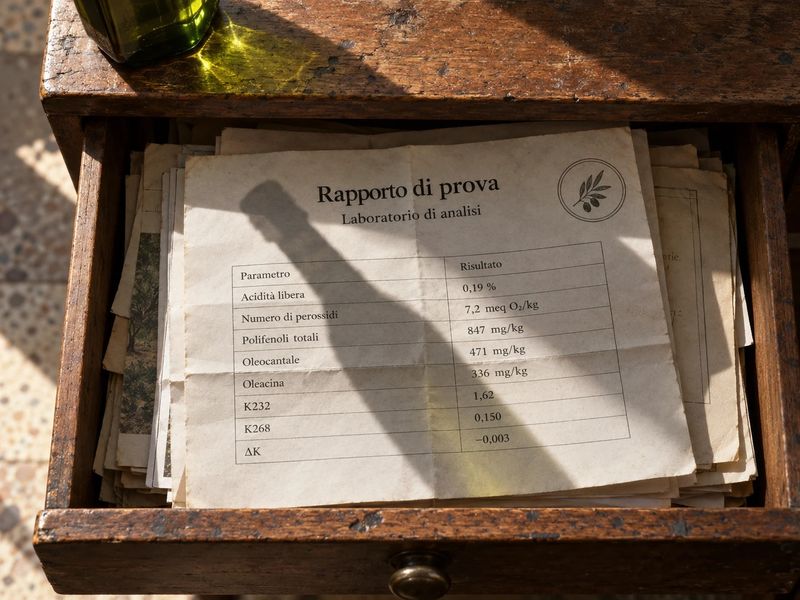
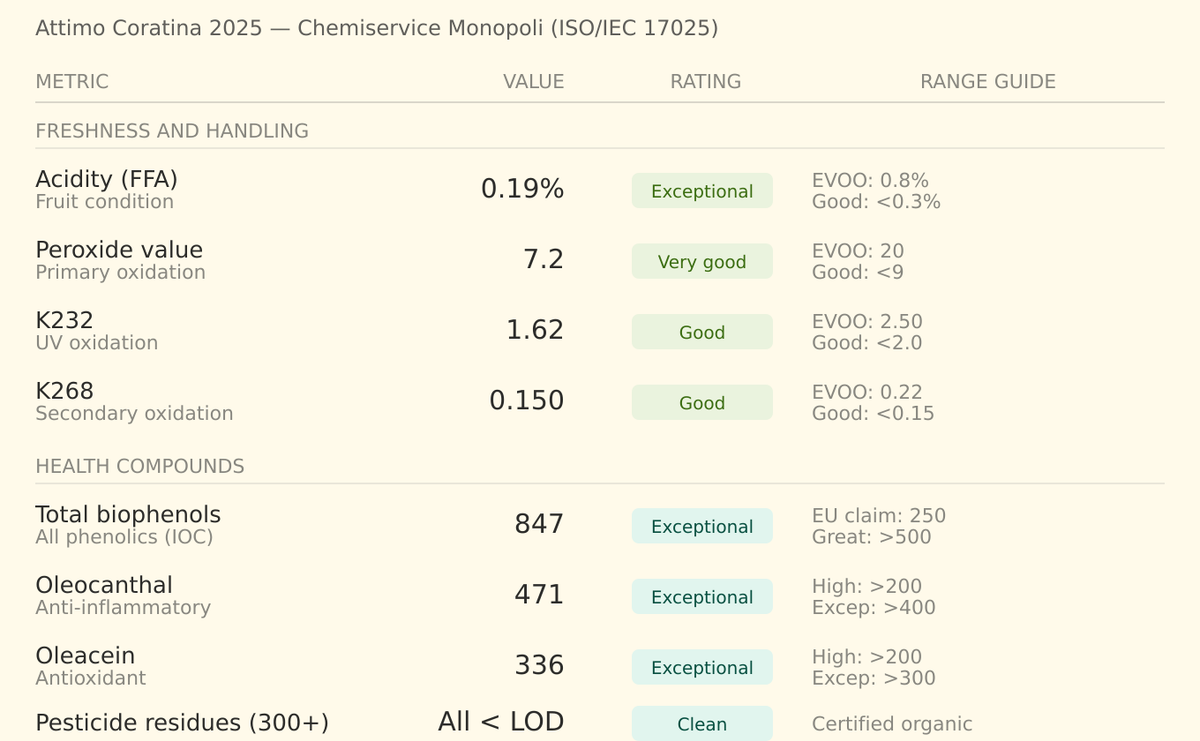
A trained palate catches defects: rancidity, mustiness, fermentation. No palate detects dilution with refined or seed oil; that takes a laboratory. What your mouth can verify is freshness — the bitterness and the peppery sting at the back of the throat are the polyphenols. For everything else there's the lab report, and we've written a guide to reading one.
Most of these come down to trusting the label or the look instead of the taste and the harvest date. Get those two right, and the rest sorts itself out.
FAQ
Is cold pressed olive oil better?
No. Pressing without heat is the standard for extra-virgin olive oil, so the phrase describes nearly every bottle on the shelf. It can't separate a good oil from a mediocre one.
How can you tell if olive oil is high quality?
Look for a harvest date, a named variety, a specific origin, and ideally a lab-tested polyphenol count. Then taste it: fresh, high-quality oil is aromatic, a little bitter, with a peppery sting at the back of the throat.
Does olive oil expire?
It doesn't spoil the way milk does, but it degrades continuously from the day it's pressed. After 12 to 18 months, much of the aroma and polyphenol content is gone. Buy from the most recent harvest and use an opened bottle within a couple of months.
Should olive oil be kept in the fridge?
No. It thickens in the cold, and condensation from repeated temperature swings can damage it. A dark cupboard away from the stove, with the cap tight, is all it needs.
Is it safe to fry with extra virgin olive oil?
Yes. Its monounsaturated fat and polyphenols make it one of the more heat-stable oils at home-cooking temperatures. You lose some aroma and polyphenols to the heat, which is why the best bottle is better used for finishing.
How can you tell if olive oil is real?
Not in your kitchen. Home tricks like the fridge test prove nothing; detecting adulteration takes a laboratory. What you can taste is freshness, and what you can read is a certificate of analysis from producers who publish one.
What makes an olive oil healthy?
Mostly its polyphenols, the antioxidants behind the bitterness and the peppery finish. Their level varies several-fold between bottles, from under 100 mg/kg in typical supermarket oil to 400–900 mg/kg in early-harvest oils, and the EU's only permitted health claim requires a minimum level to apply.