What Is Specialty Olive Oil?
Twenty-five years ago, coffee was a vacuum brick of pre-ground powder. It came from nowhere in particular, it tasted the way it always tasted, and nobody asked more of it.
Then a different coffee appeared. A named farm in Ethiopia. A roast date on the bag. Someone behind a counter explaining what altitude does to acidity. The product had always been possible; what changed was that growers, roasters and drinkers began treating coffee as a fresh agricultural product with an origin, a season and a craft — and gave that treatment a name.
Specialty coffee went from insider vocabulary to established category in roughly two decades. Today it has a standards body, a scoring system, and a café in every city that considers itself a city. Roast dates are printed as a matter of course, single farms are named on menus, and an entire generation orders by process and origin. The vacuum brick still exists and still sells. Nobody confuses the two products anymore, because the word holds them apart.
Olive oil is earlier on the same road. The producers exist, the chemistry exists, the competitions exist. The name has not settled yet.
What is specialty olive oil?
Specialty olive oil is extra virgin olive oil produced to maximise character — the flavour and the health compounds of the fresh fruit — and sold with the evidence to prove it.
Break that down:
- Extra virgin is the legal baseline: acidity below 0.8%, zero defects at a tasting panel. Every specialty oil is extra virgin. Very few extra virgin oils are specialty — the grade is a floor, and the floor is low.
- Character is measurable. The flavour of an olive oil and its health value come from the same families of fragile compounds: polyphenols and volatile aromatics.
- Produced to maximise it means the producer takes a specific set of decisions — about variety, harvest timing, speed and origin — that raise character at the cost of volume.
- Sold with the evidence means those decisions are stated in checkable form: cultivar named, origin named, harvest date printed, lab analysis published.
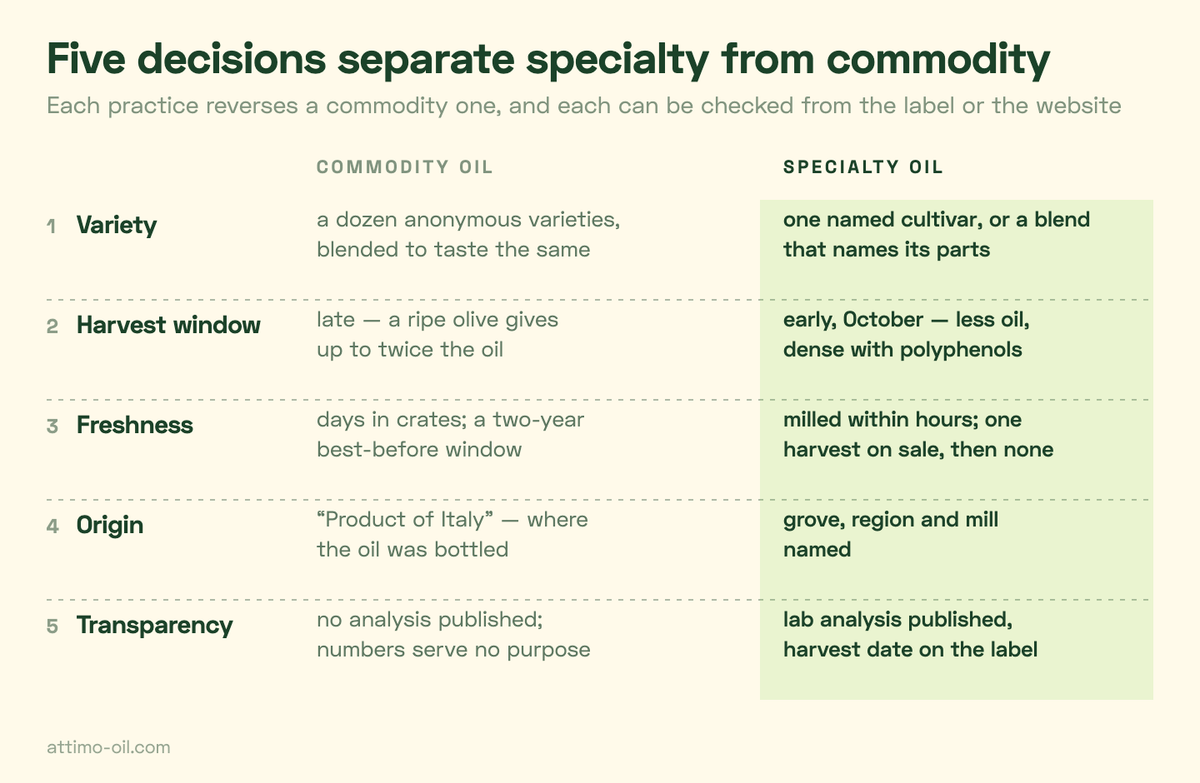
The decisions sort into five dimensions:
- The variety — honoured, as a monocultivar or a deliberate blend
- The harvest window — early, on purpose
- Freshness — hours from tree to press, one season on sale
- Origin — a place you can point to
- Transparency — the four dimensions above, in checkable form
Each is a deliberate reversal of how commodity olive oil is made.
Polyphenols and aromatics carry both the flavour and the health benefits
An olive is a stone fruit, and olive oil is its juice — pressed out, separated from its water, never refined. A fruit juice that happens to be fat.
Two families of compounds dissolved in that juice carry its flavour and its health value: polyphenols and volatile aromatics.
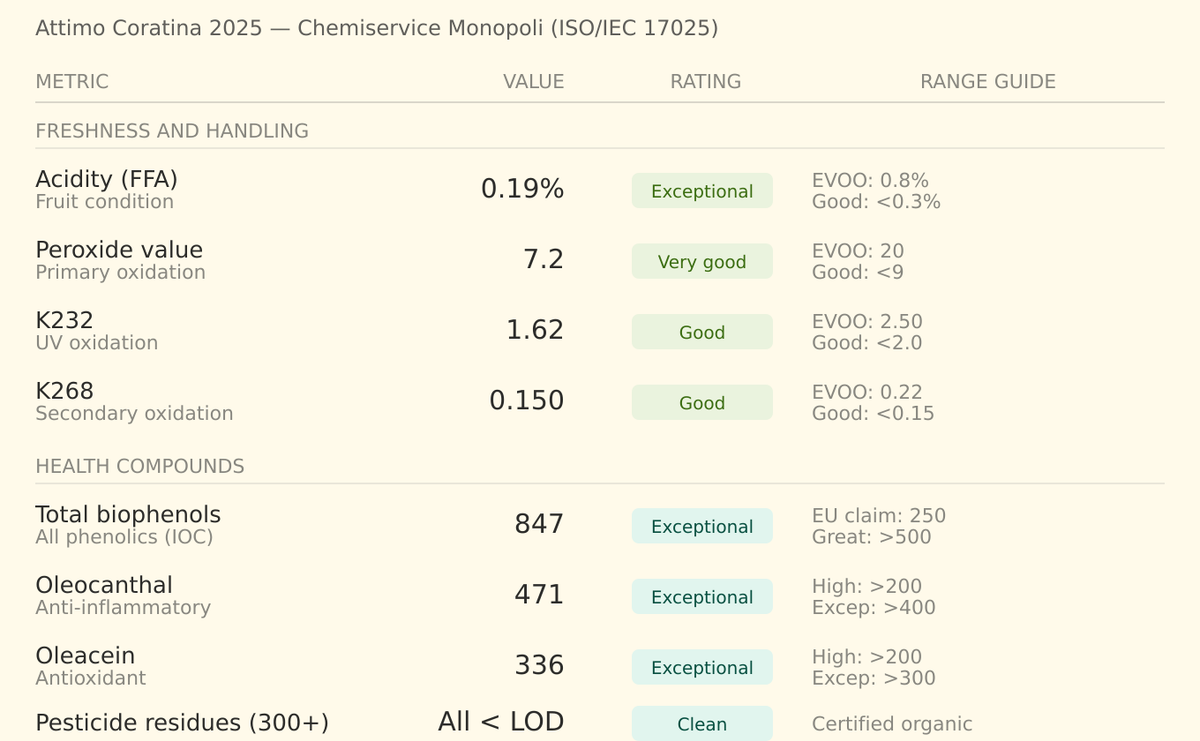
Polyphenols are the olive's defence chemistry — compounds the fruit produces against sun, insects and infection while its seed is still forming. In the oil, they are the structure you taste: the bitterness on the tongue, the pungency, the peppery catch at the back of the throat. That catch has a name — oleocanthal, a compound that inhibits the same enzymes as ibuprofen. Its sibling oleacein is among the strongest antioxidants found in food. Together with a few dozen relatives, these compounds account for most of the health research around olive oil: the cardiovascular findings, the anti-inflammatory effects, the EU's approved health claim. The claim threshold sits around 250 mg/kg of polyphenols. Most supermarket oils sit below it. Early-harvest specialty oils typically carry two to five times it.
Volatile aromatics are the smell: cut grass, tomato leaf, artichoke, green almond. They form in the minutes around milling, when enzymes in the crushed fruit build fragrance out of its fats, and they are the most fragile thing in the bottle — first to fade with heat, oxygen and time.
The same molecules that make an oil interesting to taste make it interesting to a cardiologist. This is the category's quiet advantage over wine and coffee: the geekery and the health case point at the same substance. A wine drinker chases terroir at some cost to their liver. An olive oil drinker chasing flavour is, molecule for molecule, chasing the compounds the medical literature studies.
Polyphenols and aromatics decline — with ripeness, with delay, with heat, oxygen, light and time. The five dimensions are ways of getting more of these compounds into the bottle, or losing fewer of them on the way to yours.
Dimension 1 — the variety: monocultivar, or a deliberate blend
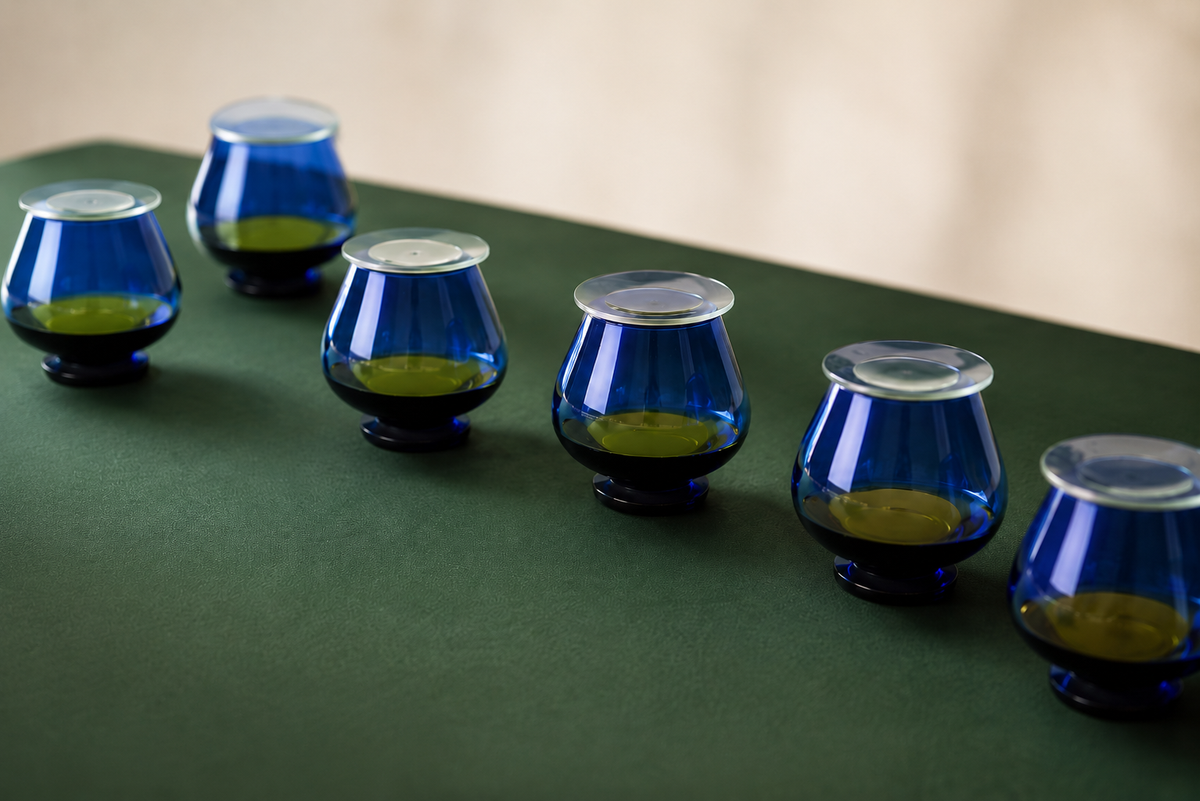
There are over a thousand olive cultivars, and they express as differently as grapes. A Coratina from Puglia presses bitter, green and peppery, with polyphenol readings among the highest of any variety. An Arbequina presses soft, golden and almondy, low in polyphenols, gone mild within months. A Nocellara sits between: gentle, fruity, tomato-leaf fresh. The distances between them are Riesling-to-Rioja distances, and a drinker can learn them the same way.
Commodity oil erases this. Tanker-scale blending averages a dozen anonymous varieties into a taste designed to be the same in March as in November, this year as last year. The variety dimension of specialty olive oil is the refusal of that erasure, and it comes in two legitimate forms.
The monocultivar is the purest form. One named variety, nowhere to hide, the full expression of what that cultivar does on that land — the olive oil equivalent of a single-varietal wine or a single-origin coffee.
The deliberate blend is the other form, and it deserves defending. In wine, blending is a centuries-old craft: a Bordeaux assembles Cabernet's structure with Merlot's flesh into something neither reaches alone. Espresso blending works the same way. Olive oil can be blended with the same intent — a bitter, structured Coratina rounded with a fruity Peranzana, composed by someone who understands both — and some of the category's future classics will be built this way. The dividing line is disclosure: a blend composed for flavour names its cultivars and proportions; a blend assembled for cost names nothing, because its recipe follows the bulk market. Respect for the variety is the dimension. A monocultivar expresses one; a deliberate blend composes several.
Dimension 2 — the harvest window: early, on purpose
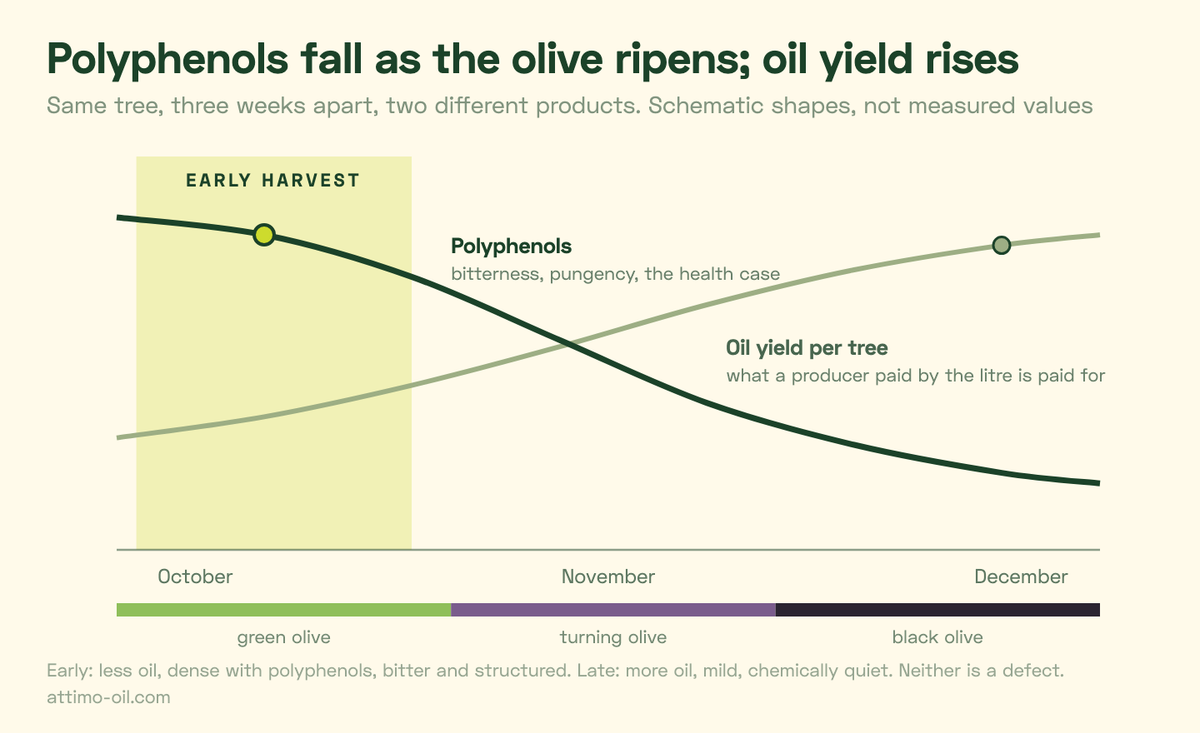
Polyphenols peak while the olive is still green — the fruit defends itself hardest while its seed is forming, then winds the chemistry down as it ripens. Oil yield runs the other way: a ripe, dark olive gives up more oil than a green one, sometimes twice as much.
So the same tree, harvested three weeks apart, gives two different products. Early: less oil, dense with polyphenols, bitter and pungent and structured. Late: more oil, mild, buttery, chemically quiet. Neither is a defect. Only one carries the compounds this category exists for.
The economics explain the shelf. A producer paid by the litre picks late, because ripeness is yield. A specialty producer picks early — October rather than December, in the northern Mediterranean — and accepts that character is bought with volume. Which is why the harvest window belongs on the label the way a vintage belongs on wine: it is not trivia. It is the single decision that most determines what ends up in the bottle.
Dimension 3 — freshness: milled in hours, sold for one season
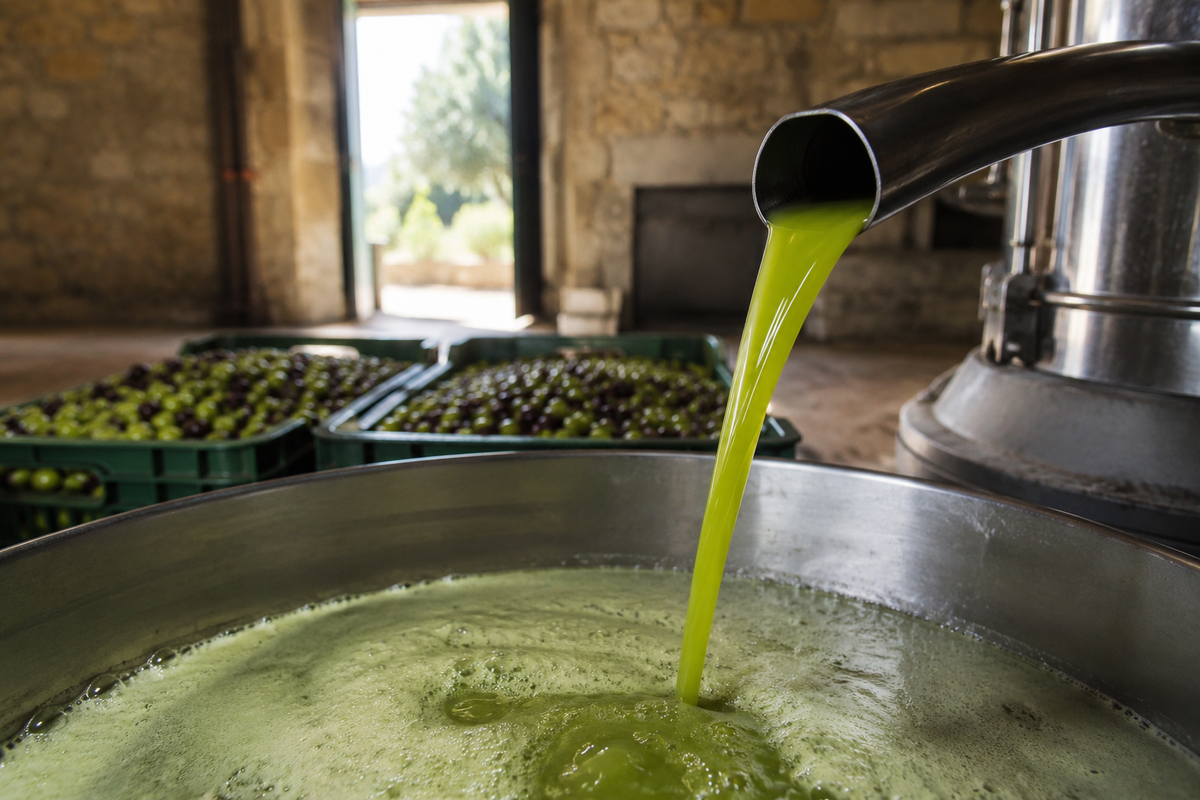
Degradation starts the moment the olive leaves the tree. Acidity is a timer: enzymes begin breaking the oil apart in any fruit that sits bruised in a crate, and every hour between picking and milling shows up in the number. An oil at 0.2% acidity was picked intact and pressed the same day. An oil at 0.7% was not, and both may legally call themselves extra virgin. Specialty producers mill within hours — often at a mill minutes from the grove — because the difference is measurable and permanent.
Pressing starts a second countdown. From that day, polyphenols and aromatics decline — faster in heat and light, slower in a cool dark cupboard, always in one direction. Wine develops in the bottle because tannins and sugars keep working; olive oil only loses. Hence dark glass or tins. And hence the season model: sell the current harvest, and when it runs out, stop until the next one — the way nobody sells last autumn's apple juice.
Dimension 4 — origin: a place you can point to
Terroir is as real for olives as for grapes. Altitude slows ripening and concentrates phenols; dry-farmed trees defend themselves harder than irrigated ones; soil and cultivar interact over centuries of selection. A Coratina from the limestone plateau around Andria and the same variety grown in irrigated flatland give different numbers and different oil. Naming the origin does two things at once: it explains the oil, and it makes the oil accountable to specific trees.
The practice runs ahead of the labelling law. EU origin rules for olive oil are coarse — a front label is often restricted to country-level claims, so a producer working from one Puglian grove may only be allowed to print "Italy" where they would rather print the region. Commodity bottling hides behind the same coarseness from the other side: "Product of Italy" on a supermarket bottle mostly records where the oil was bottled. The specialty answer is to name everything the law allows on the label and everything else in the open — grove, region, mill, producer — on the website, the analysis, the box. Origin is a traceability practice before it is a printing decision.
Dimension 5 — transparency: the other four, in checkable form
The first four dimensions are claims, and claims are cheap. Anyone can print "early harvest" over a stock photo of a grove.
Transparency is what converts the claims into statements that can be verified: the cultivar named, the origin named, the harvest date printed, and — the decisive habit — the lab analysis published. Polyphenols in mg/kg. Acidity. Freshness markers. Sometimes the individual compounds, oleocanthal and oleacein, measured at an accredited lab.
Most producers publish none of this, and the reason is structural rather than sinister: most oil would test unremarkably, and the numbers serve nobody at commodity prices. Which is exactly what makes publication meaningful. A producer who publishes tested numbers accepts that their oil can be compared, harvest after harvest, against anyone else who publishes. A category is only real when its claims are checkable, and transparency is the dimension that makes the other four count.
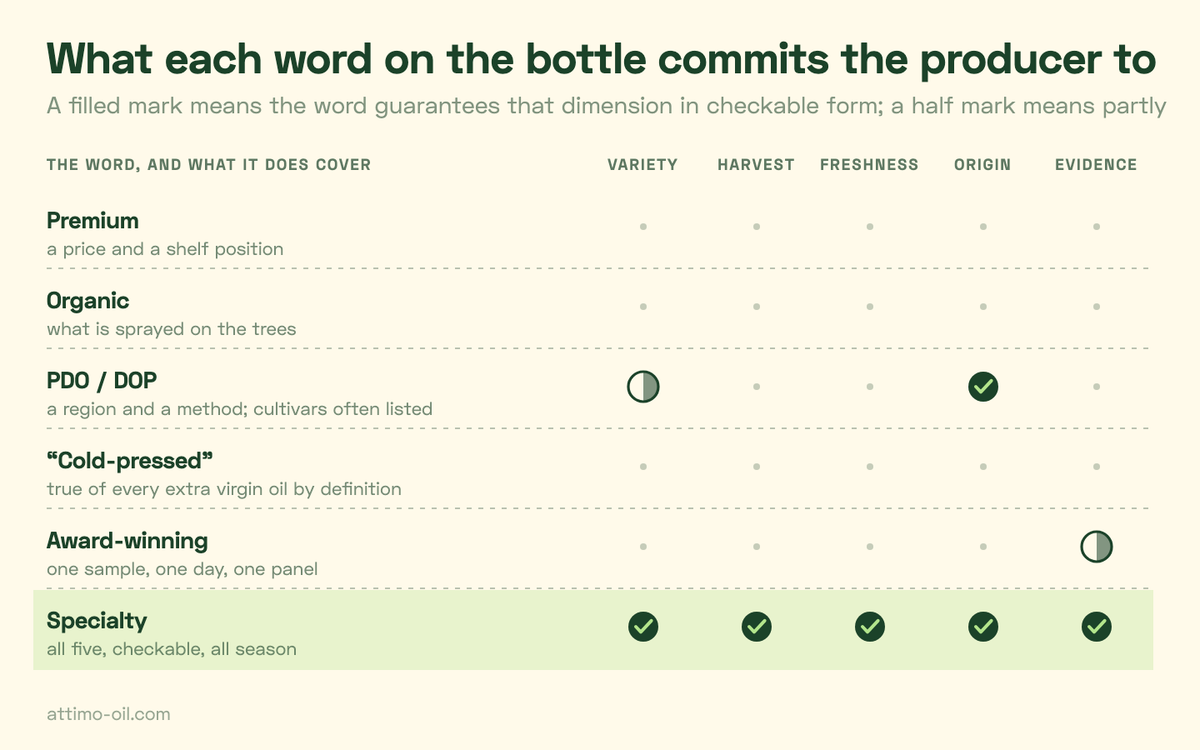
Specialty is not premium, organic, PDO, cold-pressed or award-winning
Premium. A price position. Heavier glass, better design, a higher shelf. Premium commits the producer to nothing that can be checked, and plenty of premium-priced oil is late-harvest commodity blend in nicer packaging.
Organic. A farming-input standard — real, regulated, worth having. It governs what is sprayed on the trees and says nothing about variety, harvest timing, milling speed or freshness. An organic oil can be blended, late-picked and two years old.
PDO / DOP. Protected origin designations regulate geography and method, and they overlap with one dimension of five. A PDO oil is traceable to a region; the designation is silent on harvest window, polyphenol content and published evidence.
"Cold-pressed." A relic. Every extra virgin oil is already extracted without heat, by definition; the phrase describes stone-mill equipment nobody uses and distinguishes nothing on a modern shelf.
Award-winning. A medal judges one submitted sample on one day, and taste competitions reward polish as much as character. High-phenolic competitions — which score chemistry the way cupping scores coffee — come closest to the category's logic. But an award is an event, and specialty is a standing practice: it covers everything the producer ships, all season, checkably. The two can coincide, and in the best cases they do.
What commodity olive oil optimises for
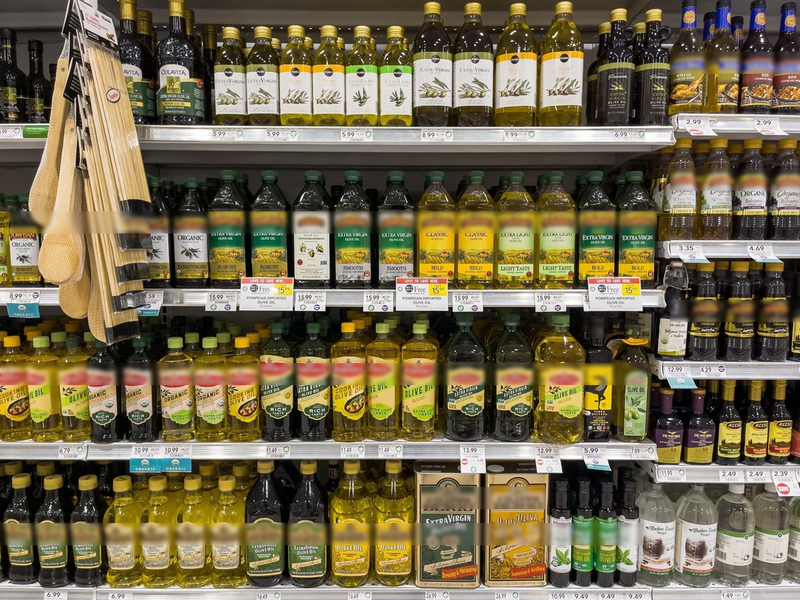
Commodity olive oil is built for uniform supply at minimum cost — none of it hidden, none of it fraud. Late harvest, because ripeness is yield. Blending across varieties, countries and seasons, because supermarkets need constant volume and a taste that never varies. A two-year best-before window, because logistics need one. No published analysis, because numbers serve no purpose at that price point. The result is legal, rational, and cheap — and it sits on the shelf wearing the same two words as an oil pressed from one grove in one October week: extra virgin.
The grading system cannot tell these two products apart. A definition can. That gap is the reason this category needs a name at all.
Wine, without fine wine
Imagine wine had never developed its culture — no vintages, no varietals, no appellations. The entire category is called "red wine". It is blended across Spain, Chile and Australia, across harvest years, to a taste engineered never to change. The label names no grape, because the recipe follows the bulk market. It carries a best-before date and no year. It costs four euros and it always tastes the same.
Nothing in that picture is technically impossible. It never happened because fine wine got there first — centuries ago, before industrial blending had the infrastructure to win. Coffee had no such head start, industrialised completely, and then clawed the category back within living memory.
Olive oil is the described picture. It is wine without fine wine, coffee before 1990 — a fresh agricultural product living under commodity rules, with its counter-movement already producing but still unnamed.
The chemistry, producers and competitions exist — the consumer word doesn't
The infrastructure is further along than the vocabulary.
The chemistry is mature: polyphenol totals, compound-level breakdowns, freshness markers, all measurable at accredited labs for a few hundred euros a season. High-phenolic competitions in Greece score oils on measured compounds, the way cupping scores coffee. Producers across Puglia, Crete, Andalusia, California and beyond have been working to these practices for years — early harvest, single cultivars, published analyses — mostly without a shared word for what they have in common. A first generation of retailers curates them.
What is missing sits on the consumer side, and it is small: the word that carries the standard. Coffee's shift did not start with a regulator; it started with a vocabulary that let a person at a counter ask a different question, and the asking built the shelf. A person who can ask for specialty olive oil can recognise it, compare it, and refuse the substitute.
ATTIMO against this definition
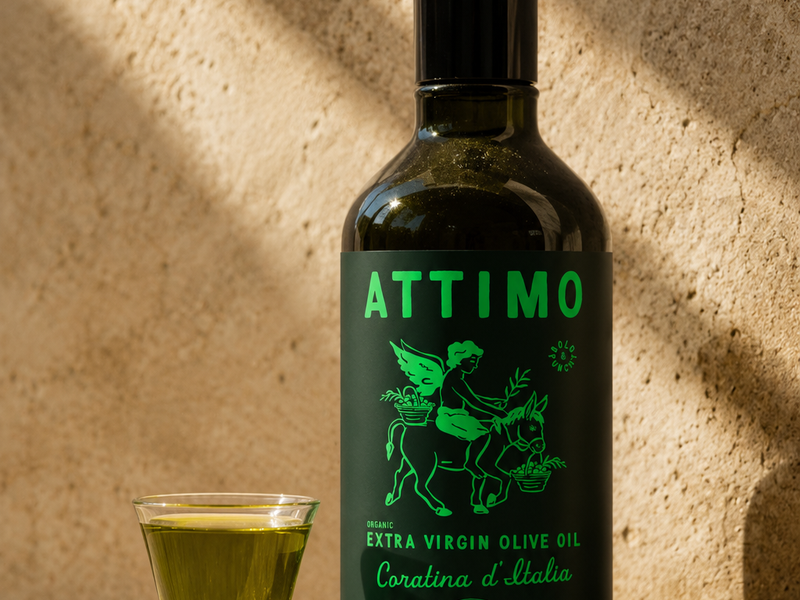
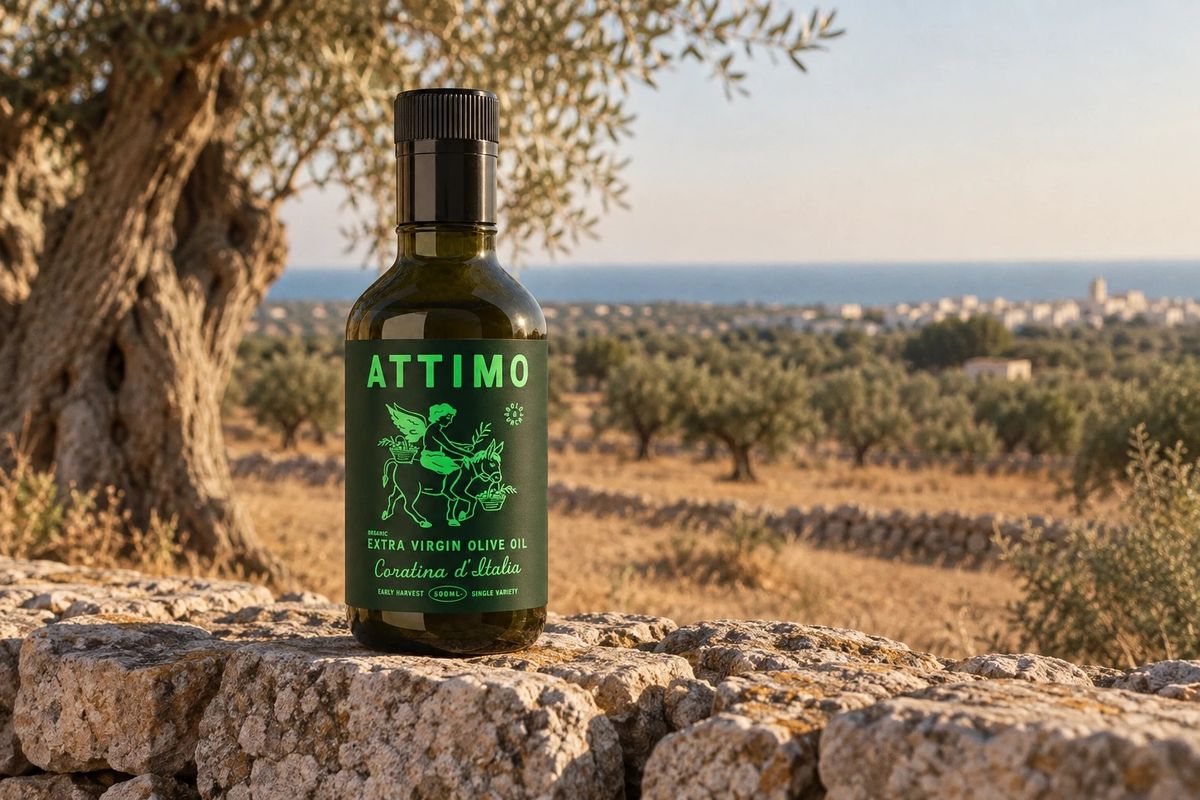
ATTIMO is built to these five dimensions — a named monocultivar in every bottle, picked in early October, milled within hours, traceable to its grove, with the harvest date on the label, the analysis published, and only the current harvest on sale. We did not invent any of these practices. We found them scattered across producers we admire, in Puglia and Sicily and Andalusia, and assembled them into a brand on purpose.
Which is why this definition is written the way it is: checkable. Hold us to it, and hold anyone else who uses the word to it.
The vacuum brick of coffee is still on the shelf. Next to it stands a bag with a farm and a date on it, and enough people reach for each that both keep existing. Olive oil is heading towards the same shelf, carried by the same kind of producers and the same kind of drinkers. The word needed writing down.
FAQ
What is specialty olive oil?
Extra virgin olive oil produced to maximise character — the flavour and health compounds of the fresh fruit — and sold with the evidence to prove it. In practice: a named cultivar (single or deliberately blended), an early harvest window, milling within hours of picking, a named and traceable origin, a stated harvest date, a published lab analysis, and only the current harvest on sale.
Can specialty olive oil be a blend?
Yes. The dimension is respect for the variety, and it takes two forms: a monocultivar, which expresses one cultivar in its purest form, and a deliberate blend, which composes named cultivars in chosen proportions the way winemakers assemble grapes. What falls outside the category is anonymous blending — unnamed varieties combined for cost and uniformity.
How is specialty olive oil different from premium or gourmet olive oil?
Premium and gourmet describe price and presentation and commit the producer to nothing checkable. Specialty describes five verifiable practices: variety honoured, early harvest, freshness, named origin, published evidence. An oil can be expensive without meeting any of them.
Is specialty olive oil the same as organic olive oil?
No. Organic is a farming-input standard: it governs what is sprayed on the trees. It says nothing about variety, harvest timing, milling speed, freshness or transparency. An oil can be organic and commodity, and it can be specialty without organic certification — though the two often travel together.
Is specialty olive oil healthier?
Generally yes, for one measurable reason: early-harvest oils carry more polyphenols, the compounds behind most of olive oil's researched health effects. The EU's approved health claim requires roughly 250 mg/kg; most supermarket oils sit below that threshold, while early-harvest oils typically carry two to five times it. The published analysis lets you check rather than assume.
How do I recognise specialty olive oil?
Five checks, all from the label or the producer's website: a named cultivar (or named blend components), an early-harvest claim with a stated window, a harvest date, a named origin, and a lab analysis you can open. A bottle passing four or five is the real thing. A bottle passing none is a commodity oil, whatever its price.
Is "specialty olive oil" an official term?
No. Extra virgin remains the only legally defined grade, and it says nothing about variety, harvest timing, polyphenols or freshness. "Specialty" today describes a practice standard the way "specialty coffee" did in its first decades: defined by producers and buyers, ahead of any institution.
Why is specialty olive oil more expensive?
Because character is bought with volume. Early harvesting can halve the yield per tree. Honouring varieties rules out cheap bulk blending. Same-day milling requires a mill near the grove. Selling one harvest per year means carrying no buffer stock. Publishing analyses costs money and removes the option of quiet mediocrity. The price difference is the production difference, item by item.